NISGUA’s Collective Timeline
This timeline is an invitation to walk through 45 years of solidarity with us. It gathers moments of struggle, accompaniment, learning, and collective strength that have shaped NISGUA’s path alongside communities in Guatemala.
As you explore it, you’ll encounter not only moments in history, but also the relationships, courage, and shared commitment that continue to guide this work today.
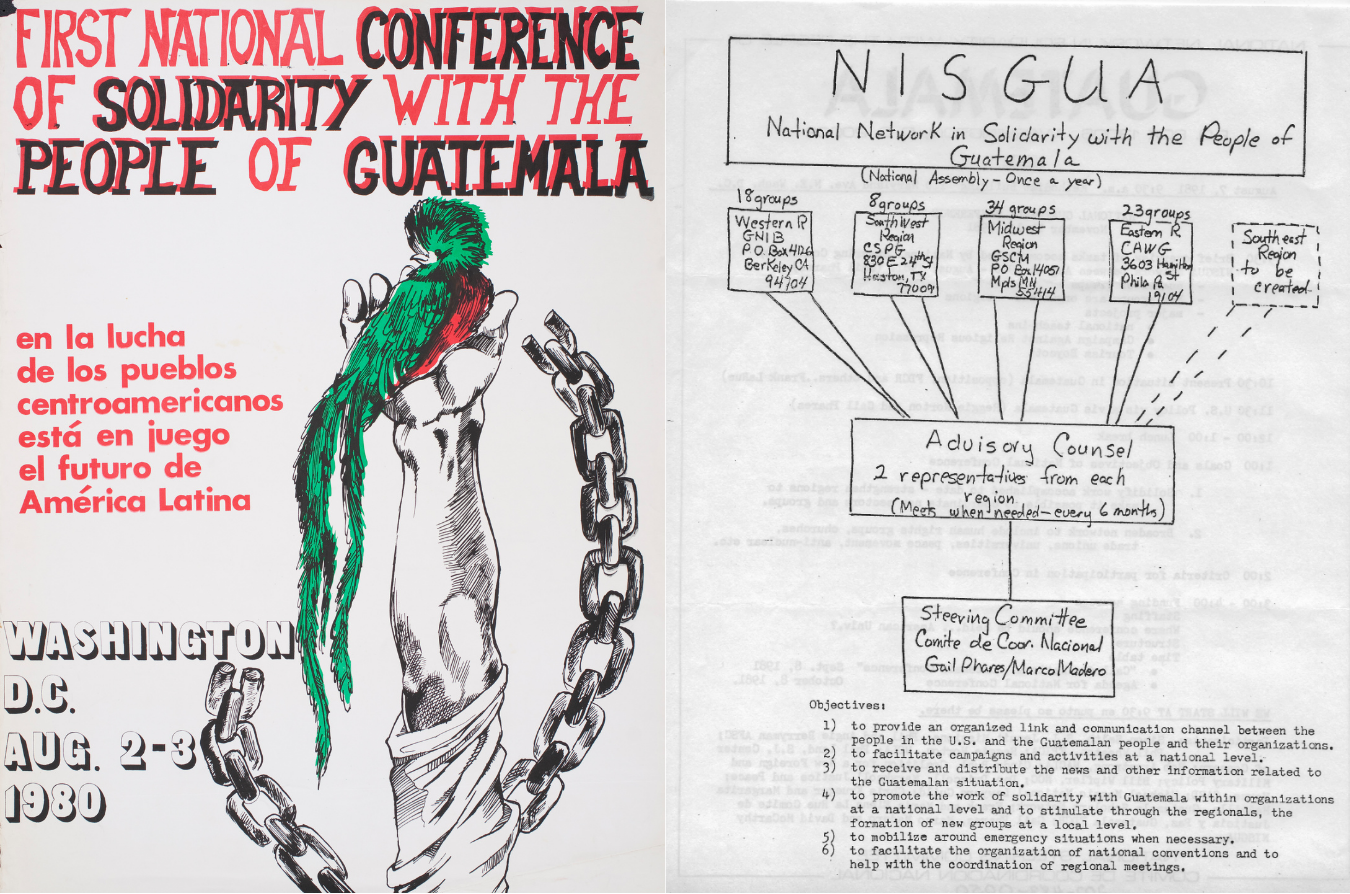
After a founding conference in 1980, existing local solidarity communities that had sprung up across the U.S. to shelter Guatemalans fleeing violence and to organize policy change came together to form the NISGUA national network to increase their political leverage and focus their advocacy potential through joint campaigns.
📸 1. Poster from NISGUA’s founding conference: “En la lucha de los pueblos centroamericanos está en juego el futuro de América Latina.” In English, Latin America’s future is at stake in the struggle of Central American peoples. Courtesy of Lincoln Cushing / Docs Populi & Todd Kolze / Guatemala News and Information Bureau (GNIB).
2. Copy of a diagram of the structure of NISGUA upon its founding.
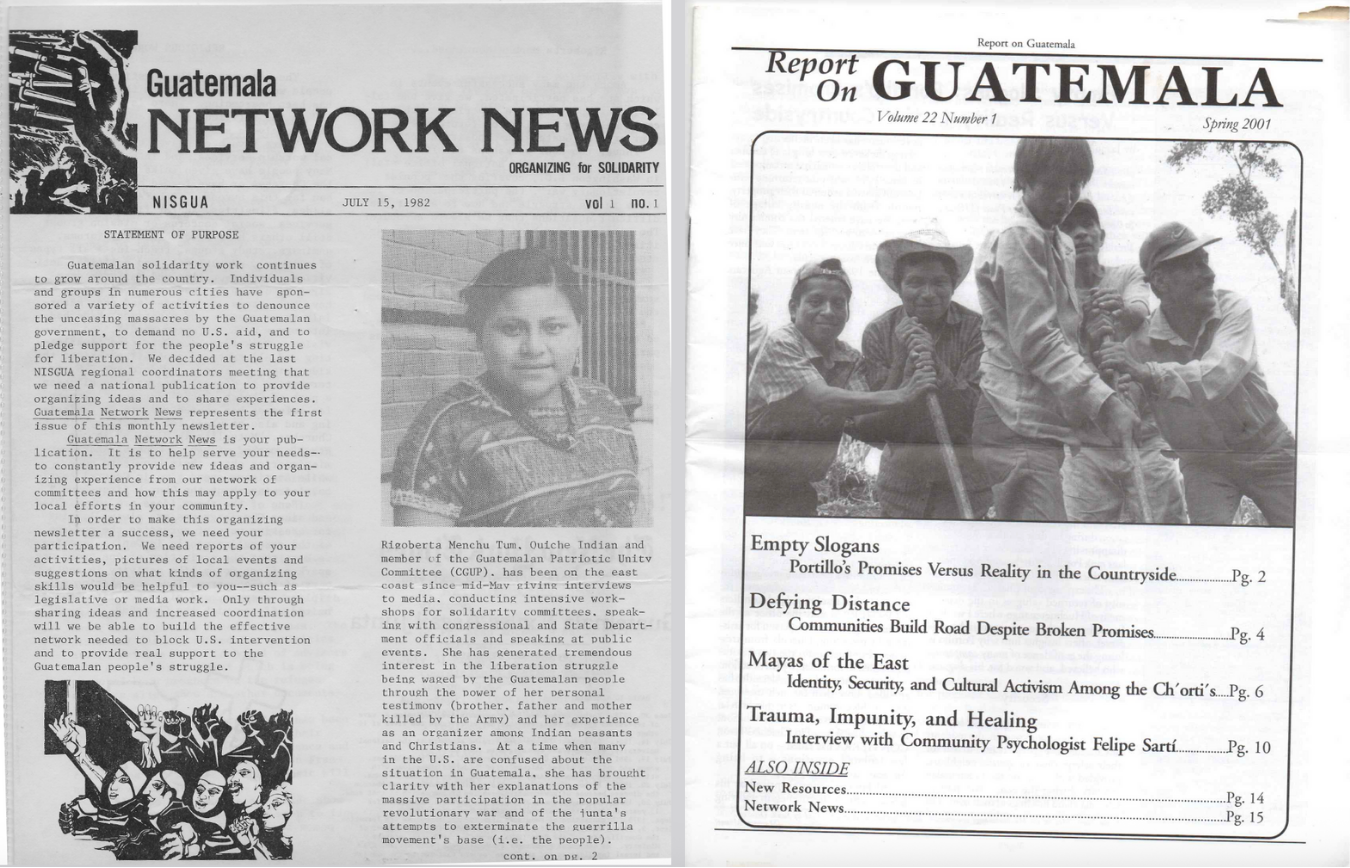
Beginning in 1982, NISGUA produced the semi-monthly newsletter “Guatemala Network News” to provide information and analysis on Guatemalan current events to network members. It was merged in 1986 with the quarterly magazine, “Guatemala!”, produced by the network’s Northern CA affiliate, Guatemala News & Information Bureau (GNIB), and renamed, “Report on Guatemala”. In 2000, NISGUA assumed responsibility for its publication. NISGUA continues this legacy with our quarterly reports and monthly online Solidarity Updates.
📸 1. 1982 copy of “Guatemala Network News,” including a photo of Rigoberta Menchu Tum, Maya Quiche.
2. Spring 2001 copy of “Report on Guatemala.”
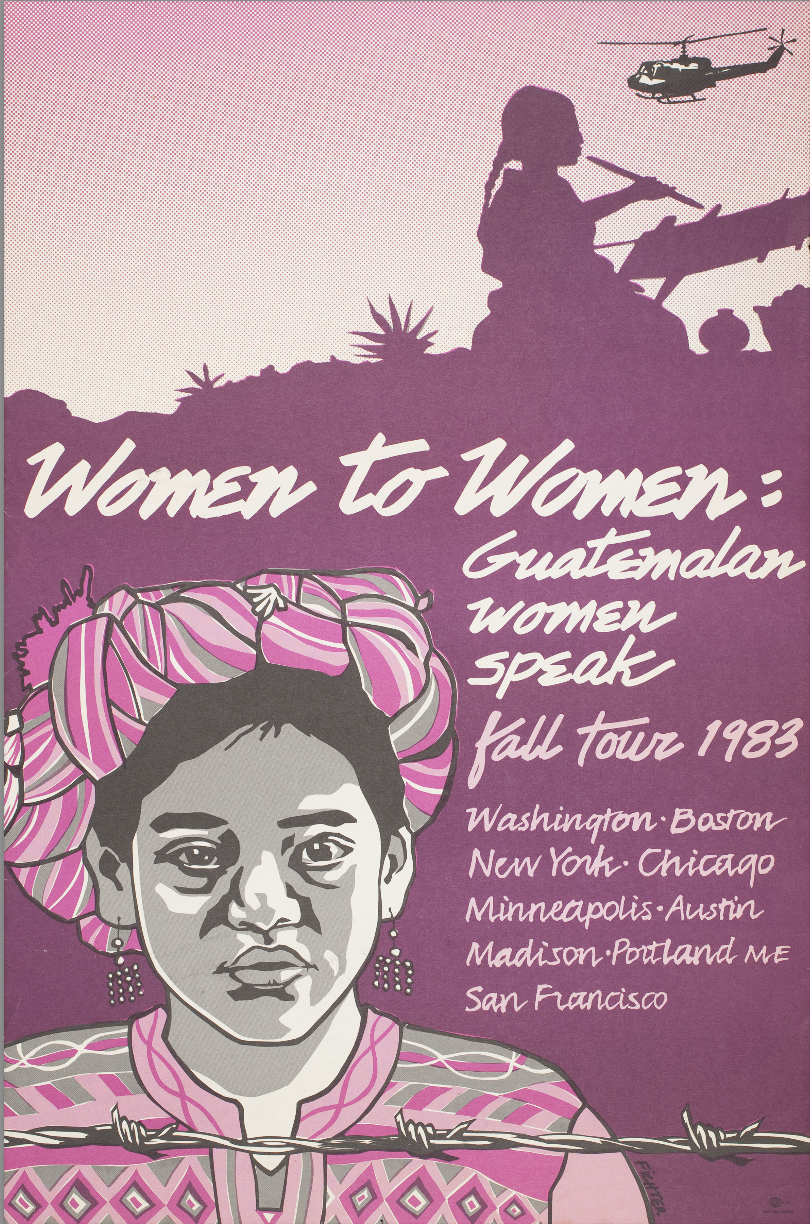
The women-to-women tour was one of our first speaking tours. We continue to facilitate annual speaking tours in which representatives of our partner organizations visit the U.S. to connect with communities about their resistances, challenges, and successes. Read more about our more recent speaking tours here.
📸 Poster from the 1983 women-to-women speaking tour. Courtesy of Lincoln Cushing / Docs Populi &Todd Kolze / Guatemala News and Information Bureau (GNIB).
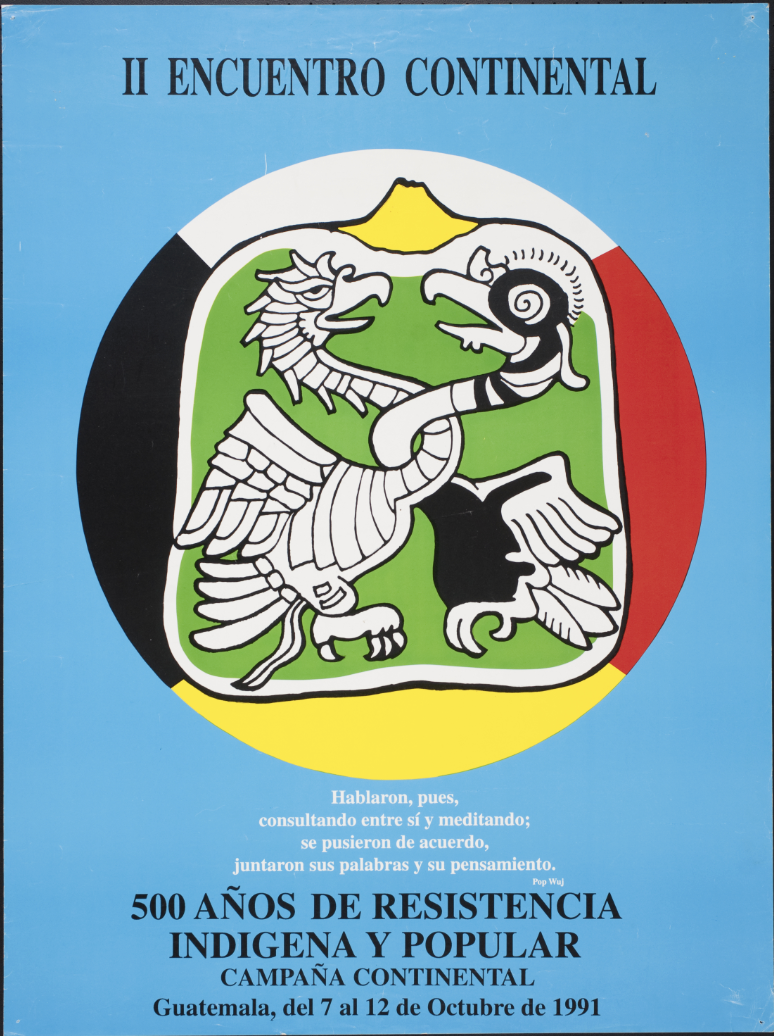
This campaign united Indigenous and popular resistances across Abiayala (the Americas, in colonial terms). NISGUA centered demands regarding land distribution, ethnic identity and rights, the debt crisis, labor conditions, and human rights in the campaign.
📸 Poster from the regional conference. Poster reads: Second continental conference. 500 years of Indigenous and popular resistance. Courtesy of Todd Kolze / Guatemala News and Information Bureau (GNIB)
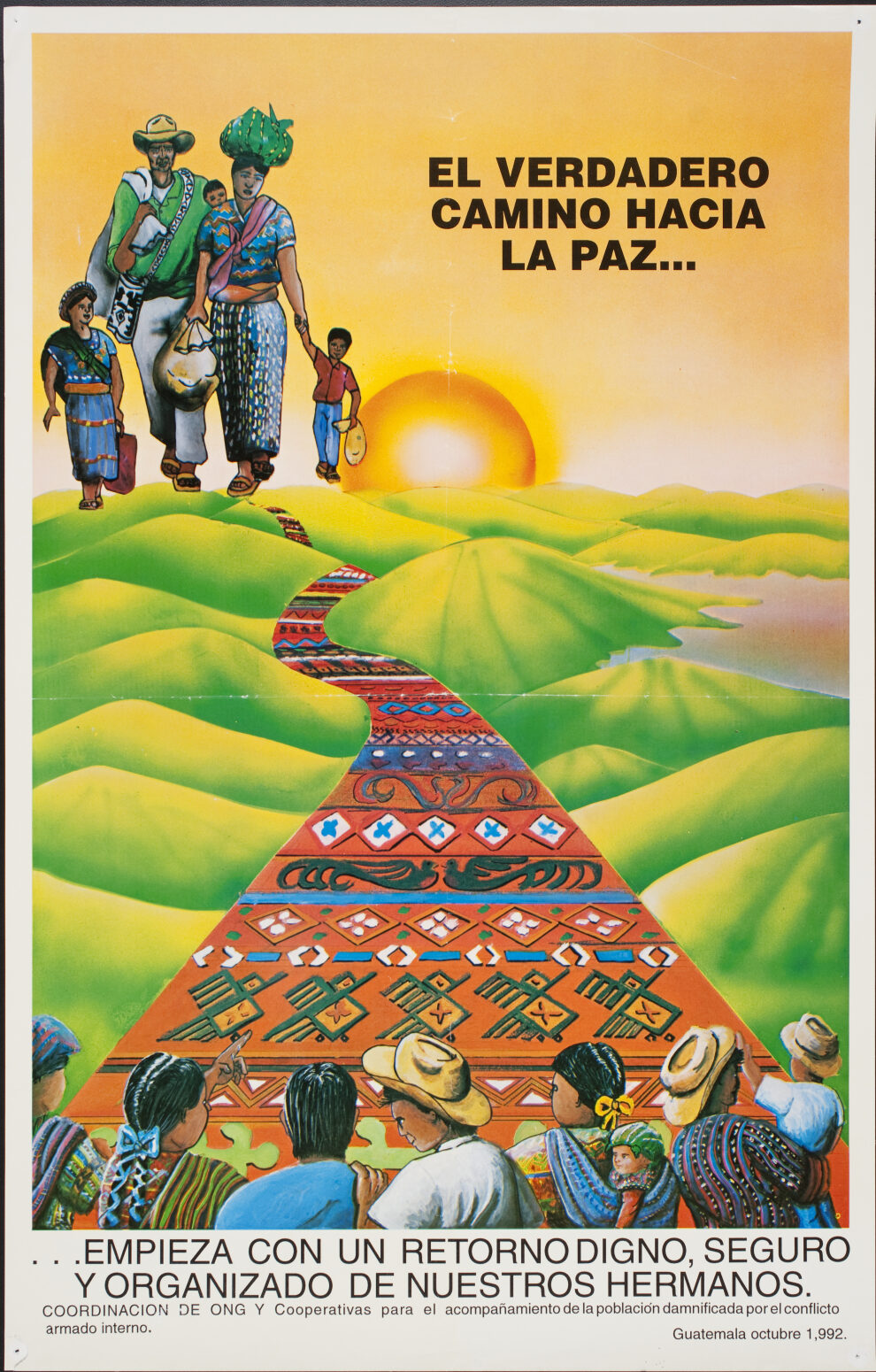
In the 1980s, some 200,000 Guatemalans fled to Guatemala to escape the scorched earth practices enacted by the Guatemalan military, trained by the U.S. government. After a decade in refugee camps, many yearned to return to their ancestral lands. In 1992, refugee leaders signed an agreement with the Guatemalan government to return. For the first time, refugees negotiated the terms of their return with the government of the country from which they fled. As a condition for signing, refugees stipulated their right to an international presence before, during, and after their return. NISGUA conveyed the significance of refugee returns to an international audience and GAP accompaniers journeyed with the refugees back to their homes, then lived with them as they rebuilt their communities and engaged in new struggles for demilitarization, social services, and the right to self-governance.
📸 Poster in support of the organized return of refugees from Mexico to Guatemala. Courtesy of Lincoln Cushing / Docs Populi and Todd Kolze / GNIB.
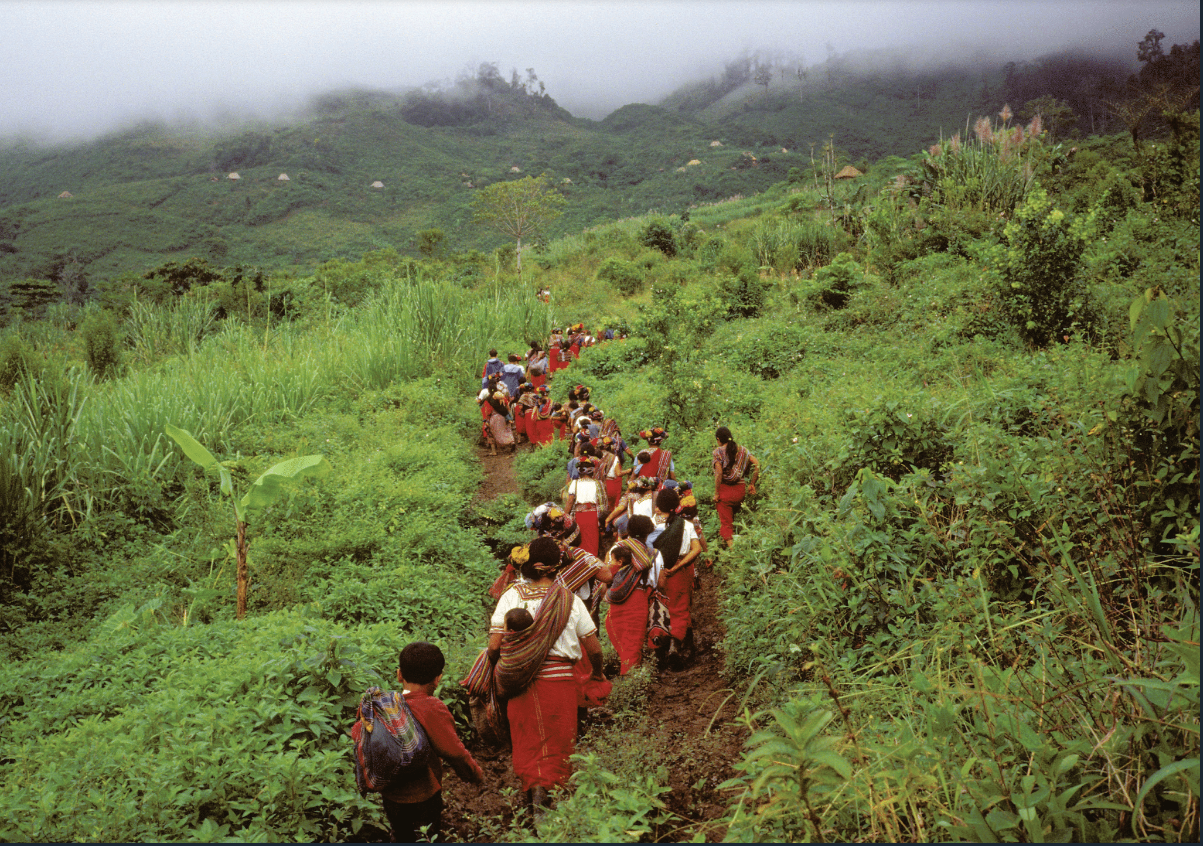
During the Internal Armed Conflict in Guatemala, thousands of families fled to the mountains and forests to escape military persecution and genocide. In 1993, the Communities of Population in Resistance (CPRs) organized a historic “walk-in.” 200 people, including NISGUA members, journalists, and religious leaders, hiked into the CPR’s concealed communities in the Ixil-Sierra region, while another 200 traveled to the CPRs in the Ixcán. NISGUA accompanied this historic process, which the CPRs call their “emergence into the light.” Later, NISGUA’s Guatemala Accompaniment Project (GAP) accompanied several CPR communities.
📸 Members of Communities of Population in Resistance (CPRs) trek to a makeshift market to exchange goods. Photo by Jonathan Jonás Moller.
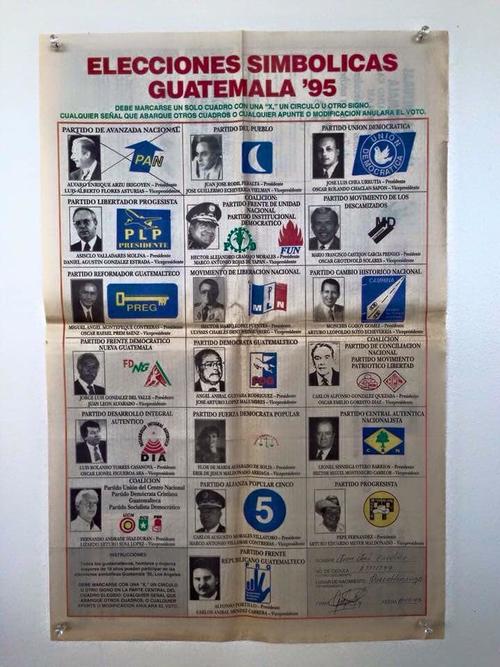
Working with the Guatemala News & Information Bureau (GNIB) and Global Exchange, NISGUA helped organize a delegation of around 40 people from the U.S. to observe the 1995 national election, the first in decades in which a wide spectrum of Guatemalan political sectors participated, including Indigenous and human rights organizations.
📸 1995 Guatemalan election ballot showing the symbolic ballot for presidential candidates and their parties. Photo by Soy 502.
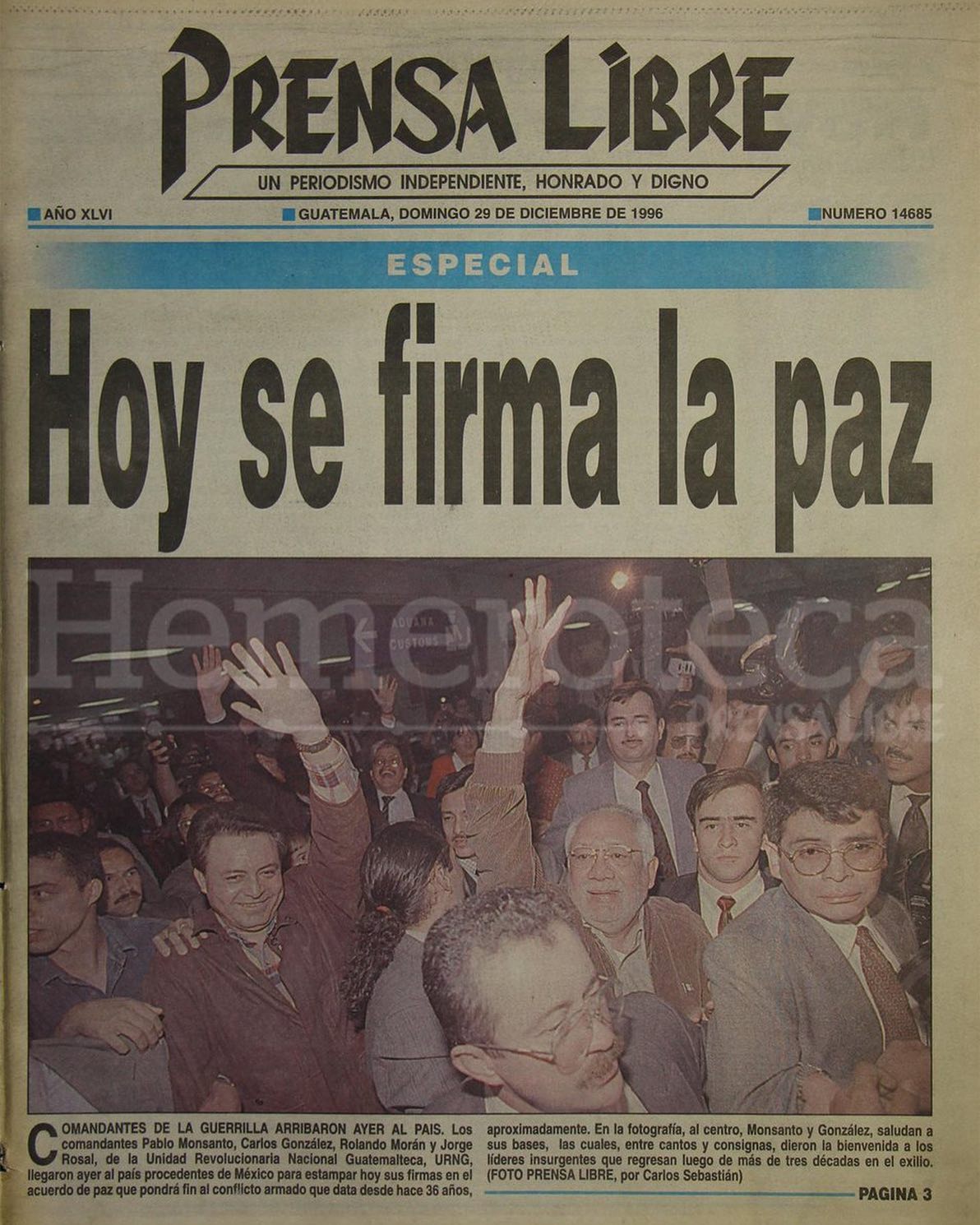
On December 29, 1996, the Agreement on a Firm and Lasting Peace was signed, formally ending Guatemala’s armed conflict, which began in 1960 following the CIA-backed overthrow of the democratic government of Jacobo Árbenz and the end of the ten-year democratic period (1944–1954).
Peace negotiations initially took place outside Guatemala and were first mediated by the Catholic Church, later by the UN verification mission United Nations Verification Mission in Guatemala (MINUGUA). At the national level, the Assembly of Civil Society (ASC) brought together multiple sectors, including for the first time the Coalition of Mayan People’s Organizations in Guatemala (COPMAGUA), representing more than 200 groups. Although the ASC produced 13 consensus documents that influenced the process, the final Peace Accords were signed only by the government and the Guatemalan National Revolutionary Unity (URNG).
📸 Celebrating the signing of the Peace Accords — front page of Prensa Libre, Guatemala, 1996.
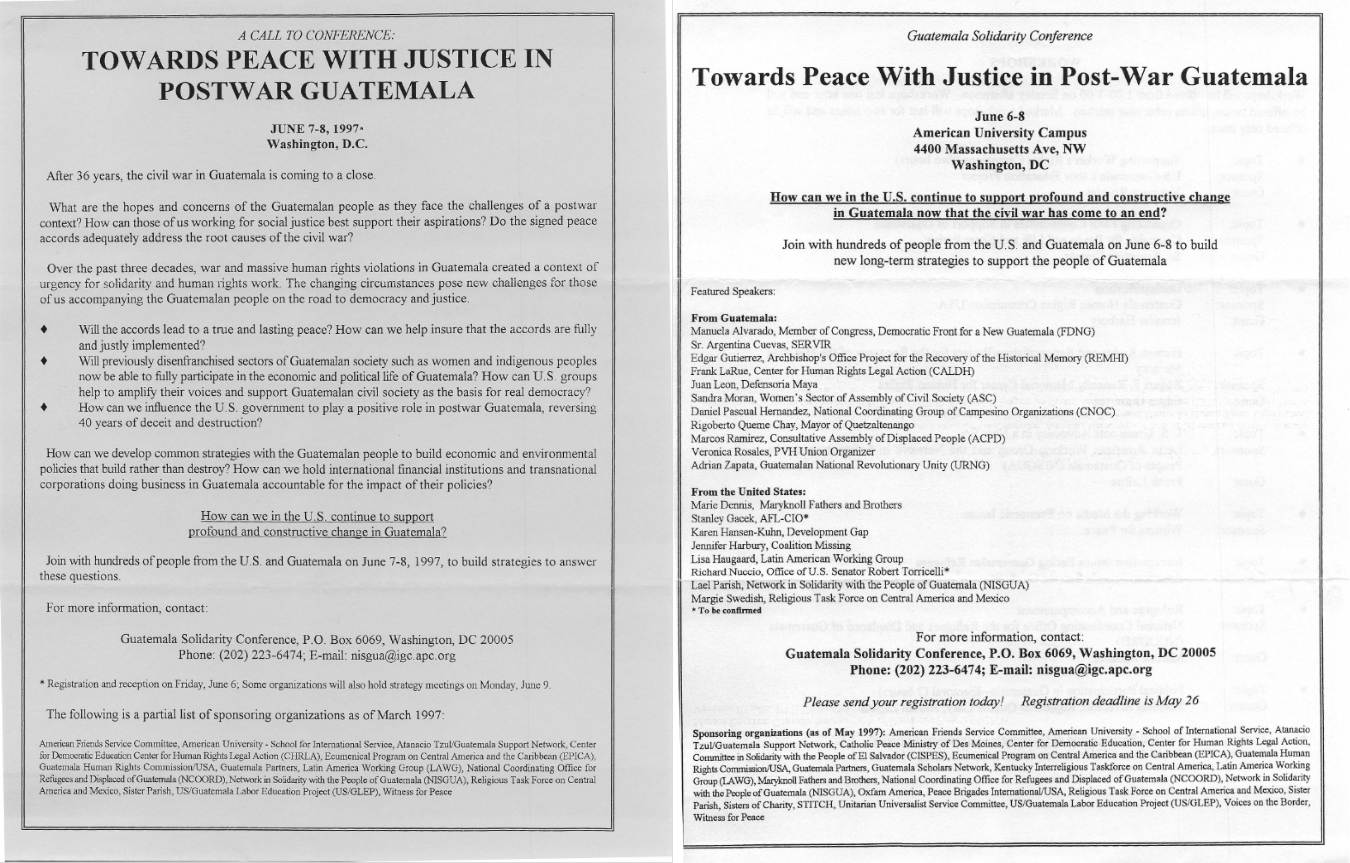
In June 1997, NISGUA convened a broad national conference in Washington D.C. to reaffirm the importance of continuing U.S.-based solidarity work following the Peace Accords and to develop a direction for future program work post-conflict. More than 300 Guatemala activists and academics from across the U.S. gathered to hear from members of the popular and revolutionary movements in Guatemala and from U.S.-based advocates. The two-day conference was followed by a one-day meeting of NISGUA affiliates to re-set priorities and strategize about the future direction of the network.
📸 1997 conference flyer: ‘Towards Peace With Justice in Post-War Guatemala’ – A solidarity conference held in Washington, D.C. addressing Guatemala’s transition after 36 years of Internal Armed Conflict.
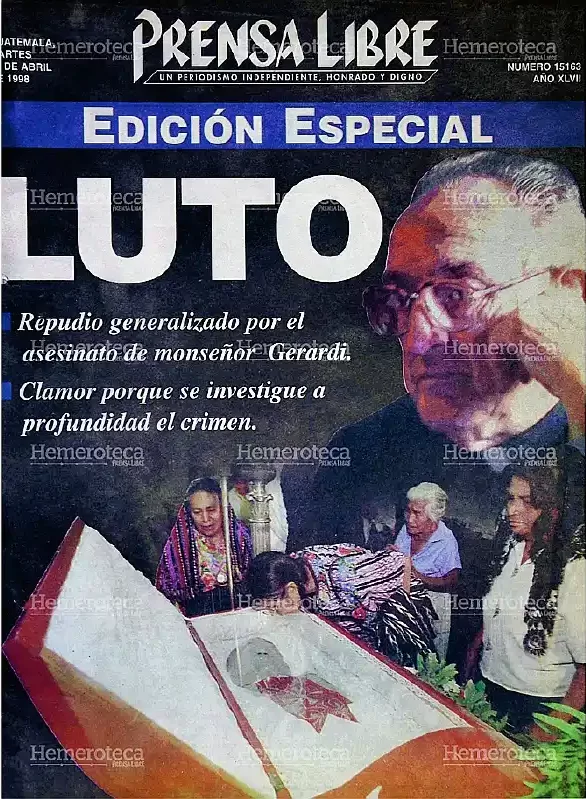
On April 26, 1998, two days after publicly presenting the Recuperación de la Memoria Histórica (REMHI), the interdiocesan truth commission report detailing human rights abuses committed during Guatemala’s 36-year civil war, bishop Juan José Gerardi Conedera was brutally assassinated in the garage of his home. Along with our Guatemalan partners and alied organizations, NISGUA responded by mobilizing our base to take action and demand justice and transparency.
📸 Special edition of Prensa Libre newspaper, depicting the aftermath of the assassination of Bishop Gerardi. Reads: Mourning: widespread condemnation for the murder of Monsignor Gerardi. An outcry for depth in investigation into crime.
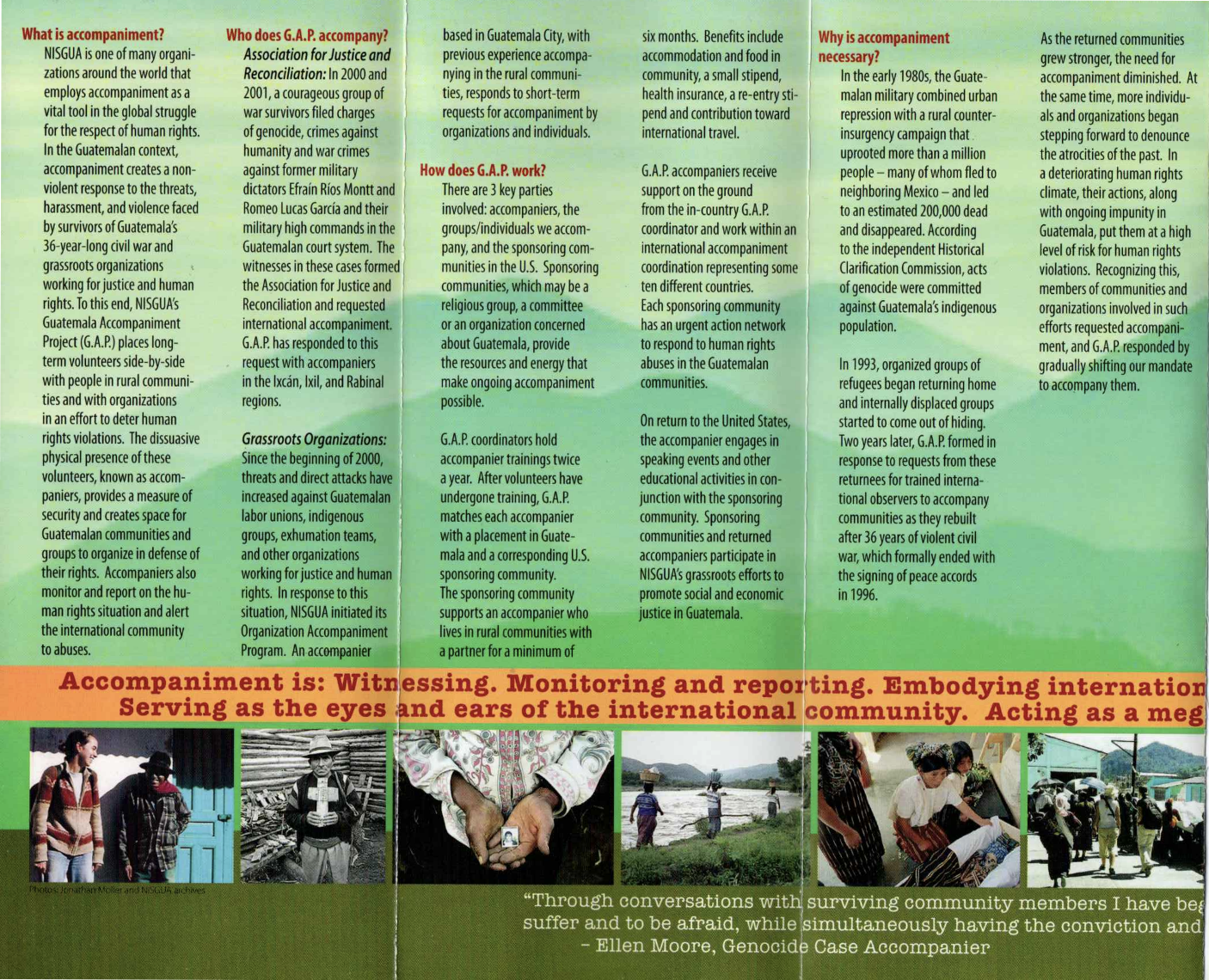
In 2001, NISGUA joined other international organizations to coordinate international accompaniment as a tool to dissuade threats against human rights defenders and open political space for them to continue their work. Our GAP volunteer program is implemented with the support of Sponsoring Communities, who are a living testimony of intergenerational and decades-long solidarity with the people of Guatemala. Read more about how our accompaniment has evolved.
📸 Brochure from the early years of GAP.
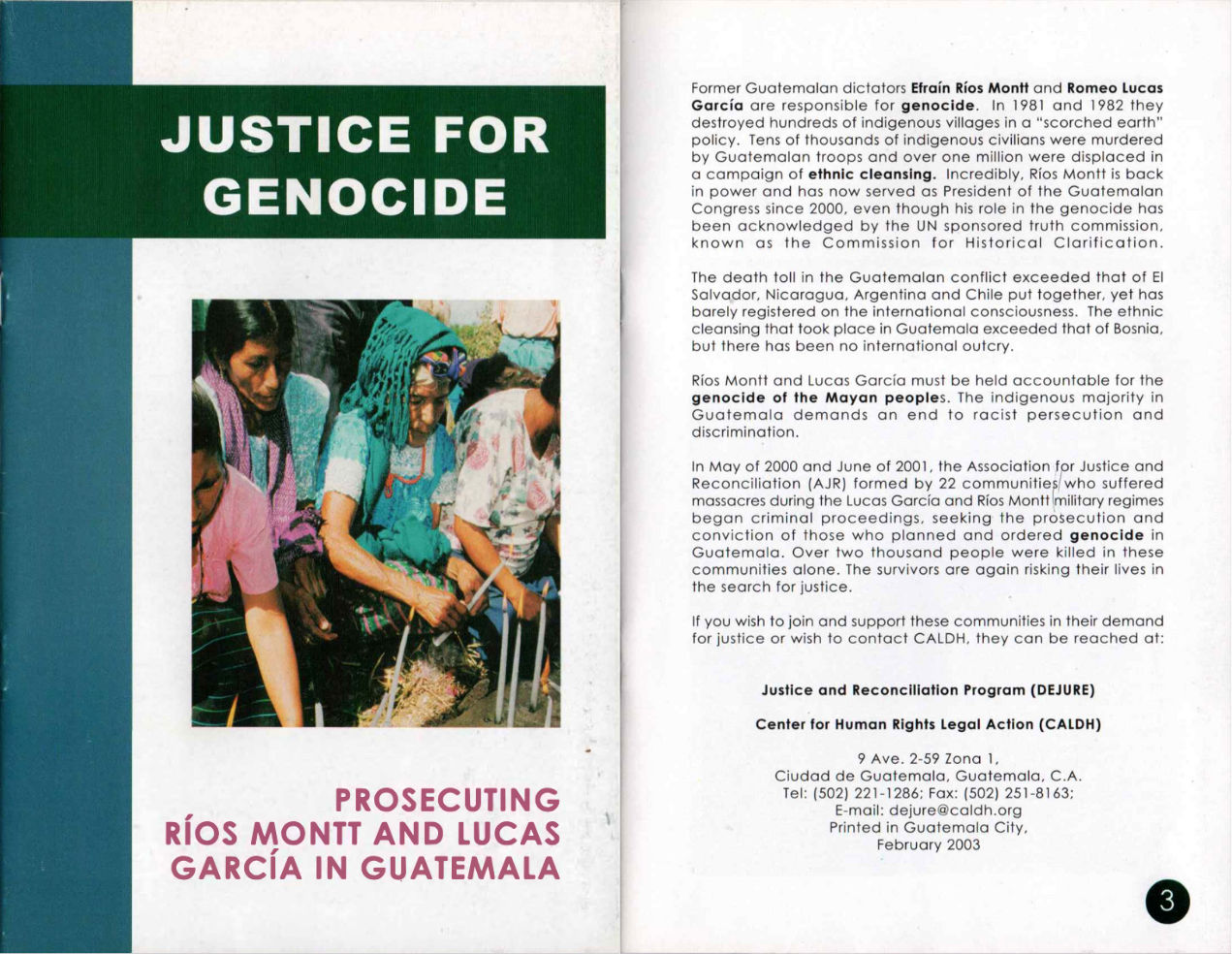
After a phase of local organizing, the Association for Justice and Reconciliation (AJR) filed charges of genocide and crimes against humanity against former dictators Romeo Lucas García and Efraín Ríos Montt and their respective military high commands. The AJR and their lawyers at the Center for Human Rights Legal Action (CALDH) requested formal international accompaniment to act as a dissuasive presence for possible attacks against the survivors during the trials.
📸 Bilingual educational resource created by CALDH and AJR.
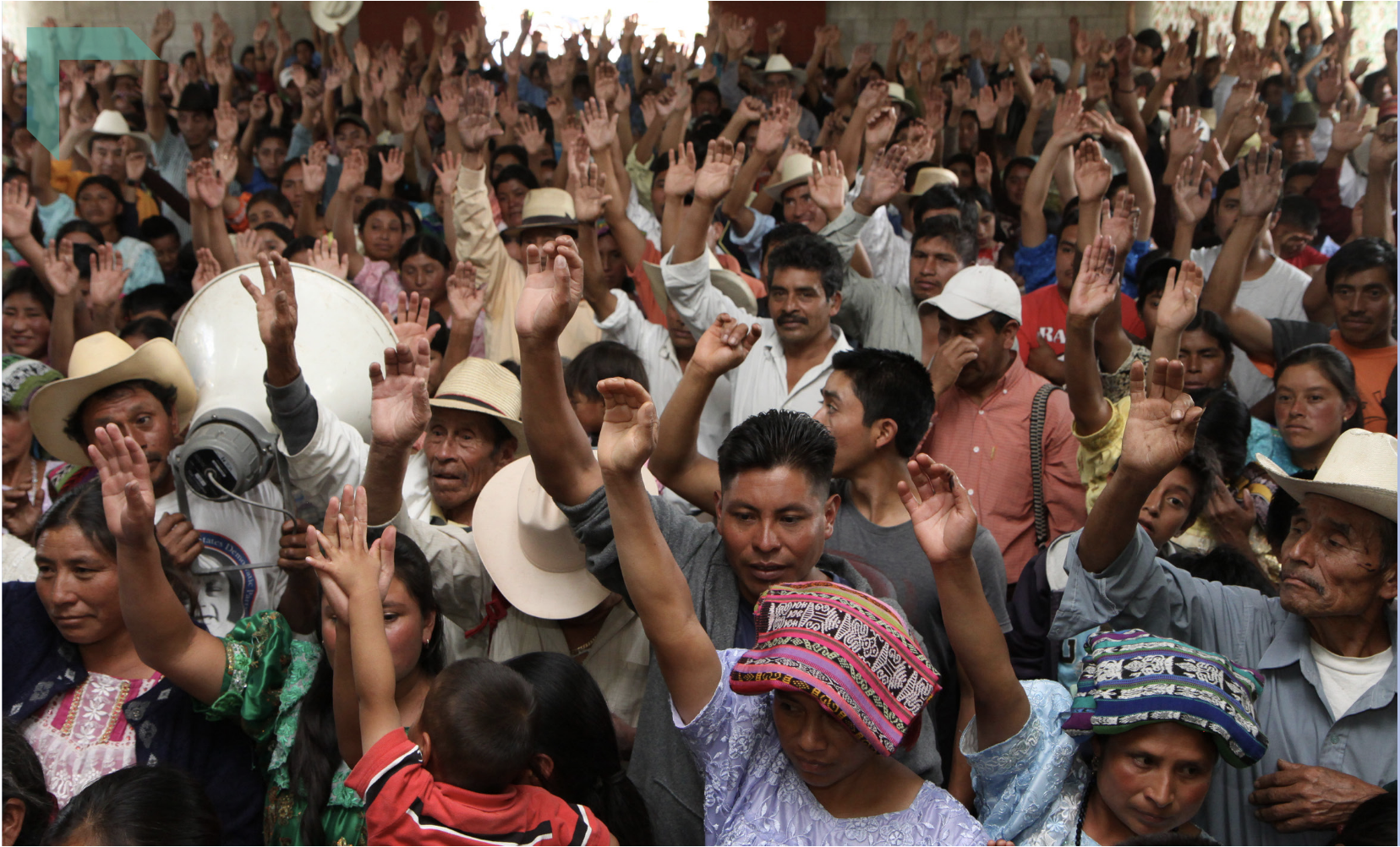
Between 2005-2010, over 80 consultations took place in 11 of the 22 departments of Guatemala. Community consultations continue to be a powerful organizing tool in Guatemalan social movements. Resistances continue to organize them when necessary, and also commemorate past community consultations as a way to maintain unity in the struggle and teach new generations about the work of their community leaders and ancestors. NISGUA still frequently accompanies community consultation commemorations and legal processes in which governmental disregard for community consultations is a key issue.
For more context, we’re sharing this 2015 NISGUA report commemorating 10 years of community consultations in defense of land and life
📸 Communities from Santa Cruz del Quiché unanimously vote against resource extraction. Photo by James Rodriguez.
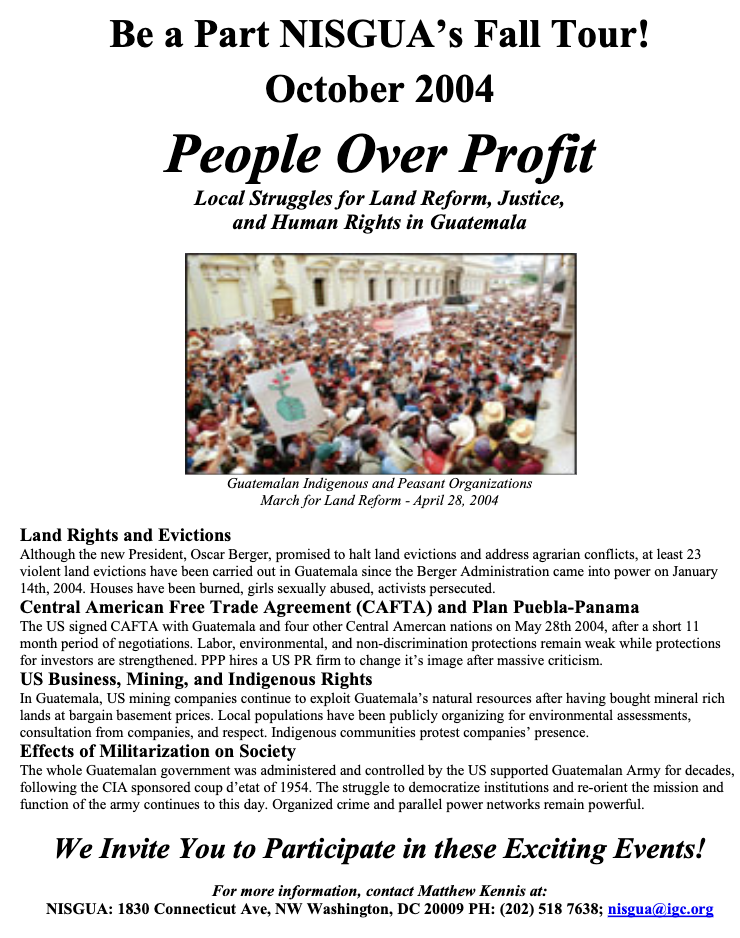
On March 10 of 2005, the Guatemalan Congress ratified the Central American Free Trade Agreement (CAFTA-DR), an agreement between Costa Rica, the Dominican Republic, El Salvador, Guatemala, Honduras, Nicaragua, and the United States. This marked the spreading of neoliberalism in Guatemala and served as another tool to continue the unequal neocolonial tradition of extractivism in Guatemala, now orchestrated by the United States. Through neoliberalism, the US now has another way to infringe upon Guatemala sovereignty using economic racialized oppression, as measures like CAFTA disproportionately impact Indigenous and Black communities.
During the CAFTA negotiations, NISGUA mobilized our base to express their concerns regarding lack of transparency and more generally about the trade agreement. Later, we organized a speaking tour featuring Carlos Humberto Muralles, who spoke about the impacts of neoliberal policies like CAFTA and Plan Puebla-Panama (PPP) on Guatemala.
📸 Flyer for NISGUA’s 2004 Speaking Tour, “People over Profit,” which featured Rudy Monterroso, Carlos Humberto Muralles, Arnoldo Yat, and Luisa Xinico Yos.
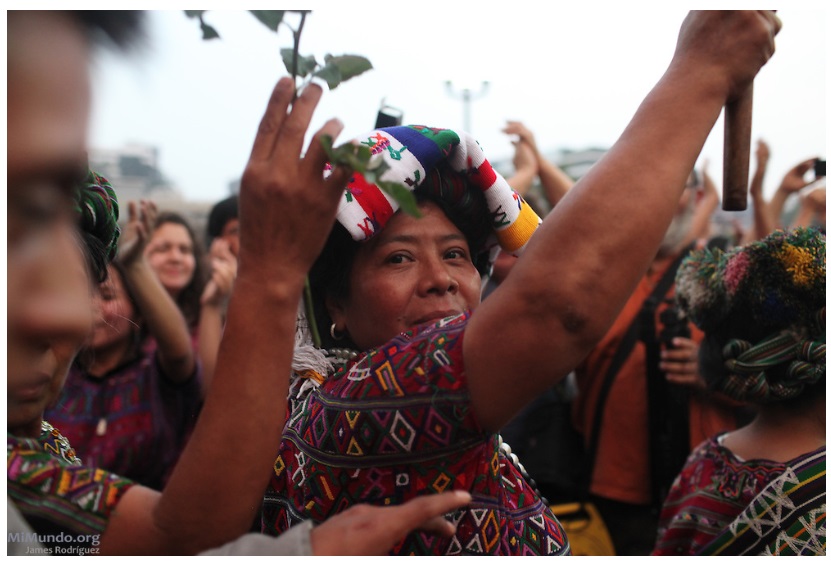
This conviction was the first in the world to find an ex-head of state guilty of genocide in the national court system of the country in which the crimes took place. This marked the culmination of 12 years of dedicated work by the Association for Justice and Reconciliation (AJR), and their legal team, Center for Human Rights Legal Action (CALDH). NISGUA accompanied these trials and provided daily summaries of what happened in the courtroom. Read the full coverage here.
📸 Ana Laynez Herrera, Indigenous Mayor of Nebaj and Ixil Ancestral Authority, raises her baton as Ixil Maya survivors exit the courtroom following the guilty verdict issued against Ríos Montt. Photo by James Rodríguez.
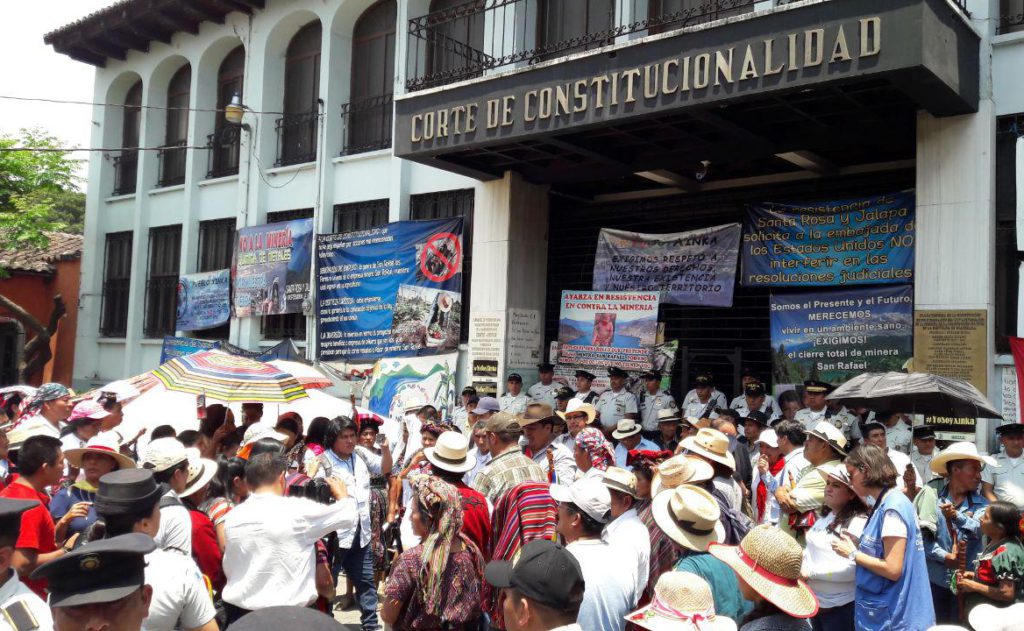
This historic ruling upheld a lower court’s June 2017 order that the then mine owner, Tahoe Resources, halt all construction. It furthermore ordered the mine to remain closed until the Ministry of Energy and Mines conducted a consultation with the Indigenous Xinka people. From the original ruling in 2017 until this announcement from the Constitutional Court in September 2018, thousands of Xinka water protectors from various municipalities maintained an around-the-clock encampment to resist the mine and call for its permanent closure. Communities resisting this silver mine continue to face surveillance, criminalization, violence, defamation, and repression. NISGUA continues to accompany the Peaceful Resistance of Santa Rosa, Jalapa, and Jutiapa against the Escobal mine. Read more here.
📸 In April 2018, thousands of water protectors gathered in front of the Constitutional Court in Guatemala City, demanding the closure of the Escobal mine and respect for the self-determination of the Xinka people.
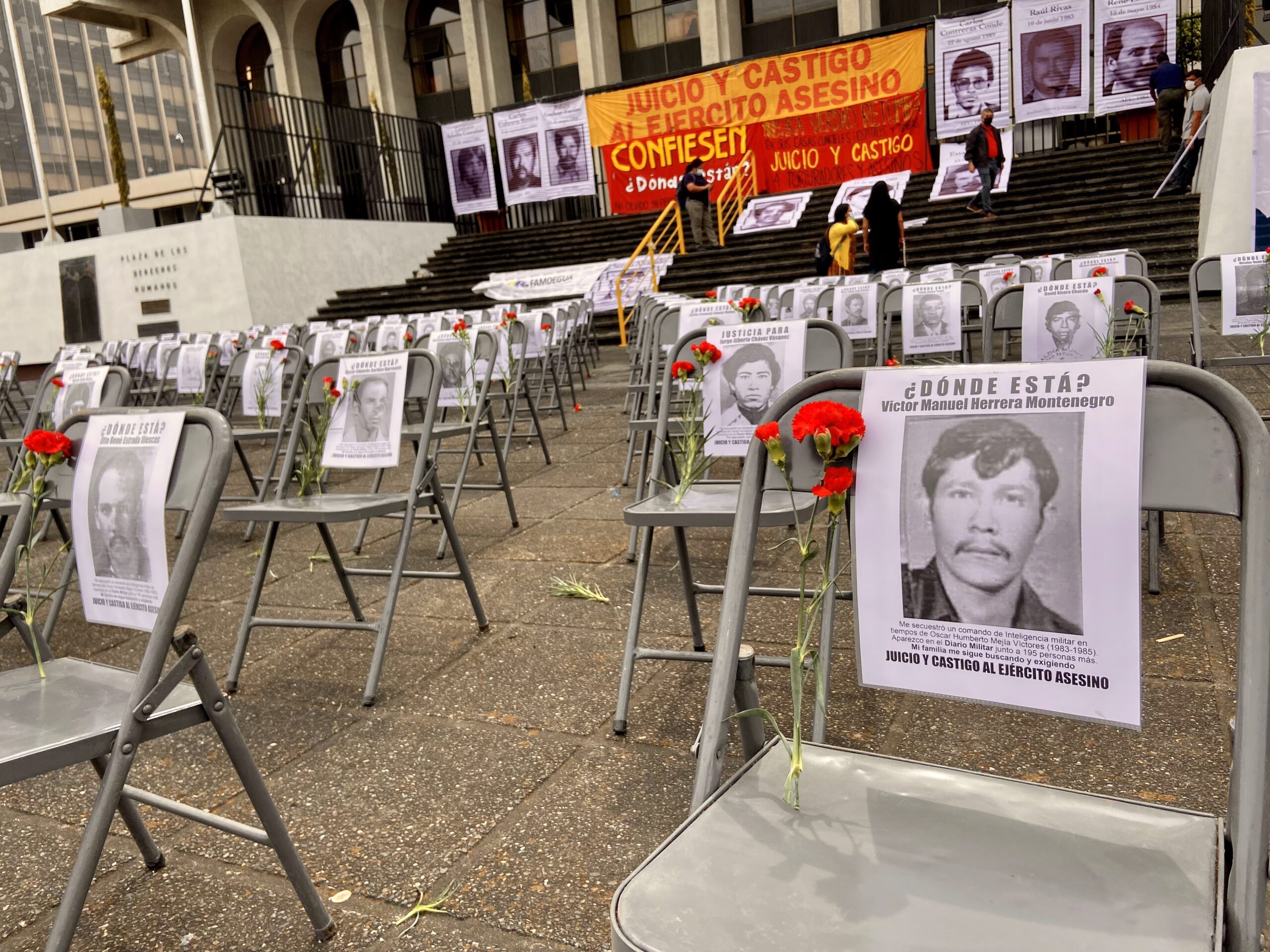
On September 26, a panel of three judges ruled that Guatemala committed genocide against the Maya Ixil people in 1982-1983. In their acknowledgement, the court specifically named Ríos Montt and his high command in what was essentially a postmortem conviction of the former dictator. The ruling marks the second time in five years that a national court has formally recognized that the Guatemalan state enacted genocide against the Ixil people. Read more here.
📸 450 chairs to represent 45,000 disappeared during the internal armed conflict. Photo by CPR.Urbana.
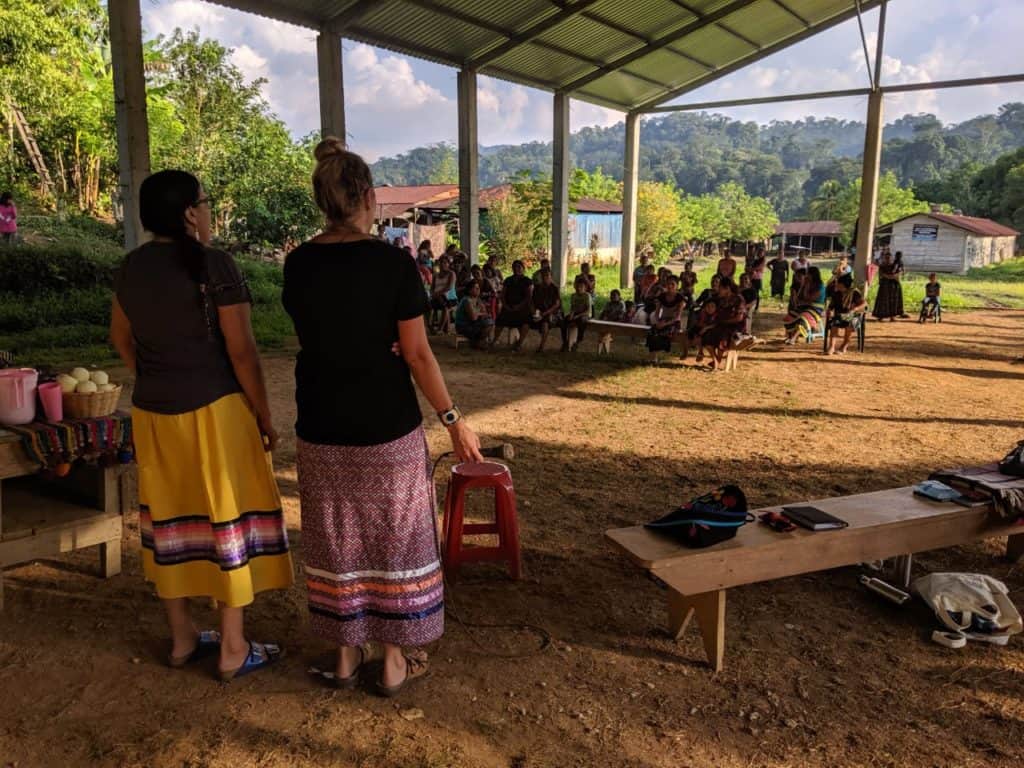
Delegations have been a part of NISGUA’s organizing model for years. We were thrilled to build on this legacy while fully centering Indigenous comrades by coordinating two Indigenous Exchange delegations in 2019. Read more about the New Mexico State University (NMSU) Indigenous Environmental Leadership Exchange here, and the Indigenous Environmental Network (IEN) Leadership Delegation here.
📸 Simone Senogles and Ozawa Bineshi Albert of IEN sing a song of struggle before the women of Copal AA.
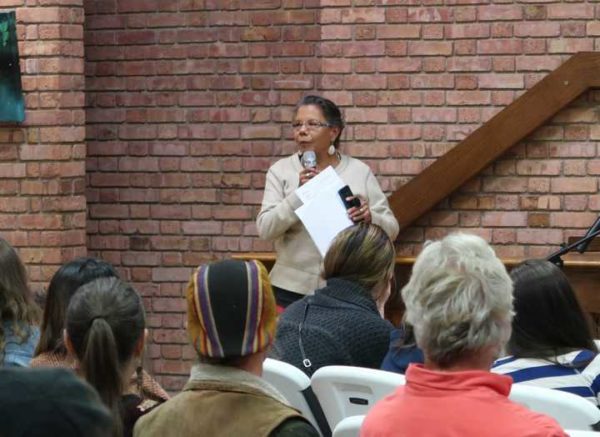
We re-launched our Guatemala Accompaniment Program (GAP) with the following goals:
- organize to link campaigns led by Guatemalan social justice movements with their counterparts in the U.S. and expand opportunities for volunteers to organize;
- strengthen relationships in communities, deepen existing partnerships, and maintain historic principles of accompaniment; and
- generate horizontal exchange between communities in the U.S. and Guatemala that are impacted by the same global systems of oppression.
📸 Rene Ann Goodrich speaks about the Missing and Murdered Indigenous Women crisis at a NISGUA screening of 500 Years, a documentary about the struggle for justice after the Maya genocides. GAP Internacionalista will continue to connect movements across borders.
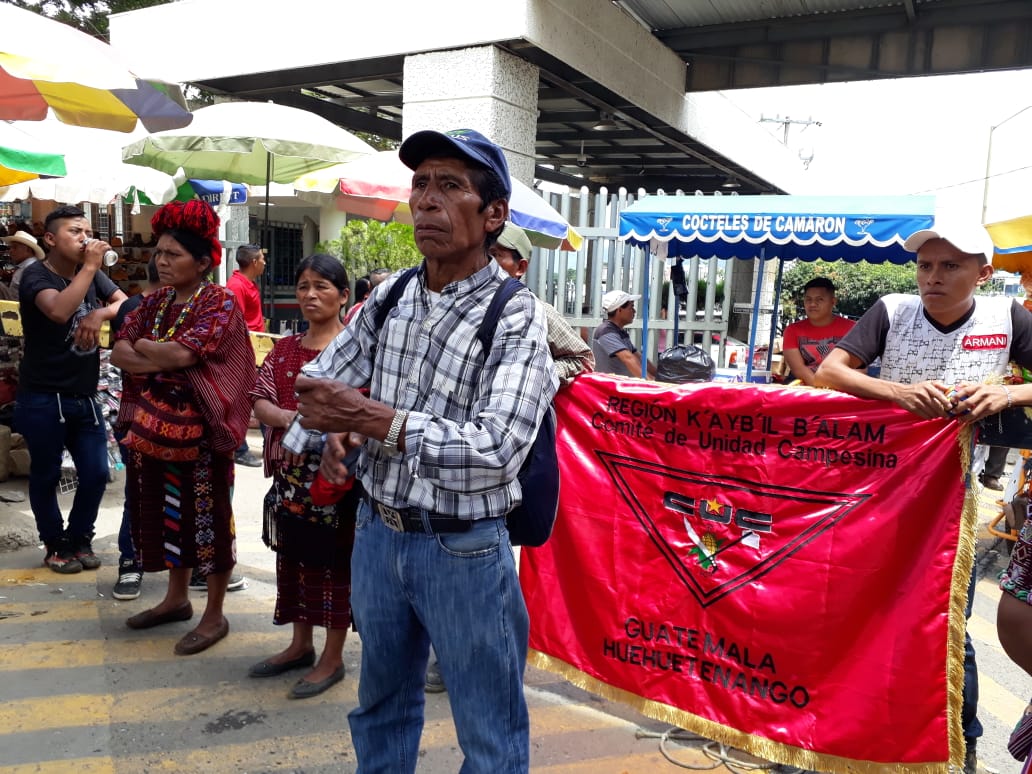
On February 5, 2021, the government of Guatemala announced the cancellation of their Asylum Cooperative Agreements (ACA) with the U.S. For over a year, NISGUA had coordinated with 40+ Central and North American organizations in a campaign to end these inhumane and illegal agreements. While we celebrated this enormous win for human dignity and safety, we honored the memory of Rubén Herrera, founder and General Coordinator of the Departmental Assembly of Huehuetenango (ADH). Rubén was the visionary behind the campaign and was instrumental to its success. The cancellation of the ACAs with Guatemala, El Salvador, and Honduras was the result of grassroots organizing across Abiayala and Turtle Island (the so-called Americas).
The cancellation of the ACAs with Guatemala, El Salvador, and Honduras was the result of grassroots organizing across Abiayala and Turtle Island (the so-called Americas). This win speaks to the importance of cross-border campaigns, a major ongoing focus of NISGUA’s.
📸 Three hundred community members organized by the ADH took over the Mesilla check point on the Guatemala-Mexico border on August 9, protesting the “safe third country” agreement, systemic impunity & the invasion of their territories by extractive industry. Photo by ADH.
In that celebration, we paused to honor those who walked with us and those who came before us. We lifted up the legacy of everyone who shaped this path, and remembered all who, over 40 years, transitioned to become ancestors.
You can revisit the 40th anniversary kick-off event by watching the recording here.
📸 NISGUA’s 40th Anniversary logo!
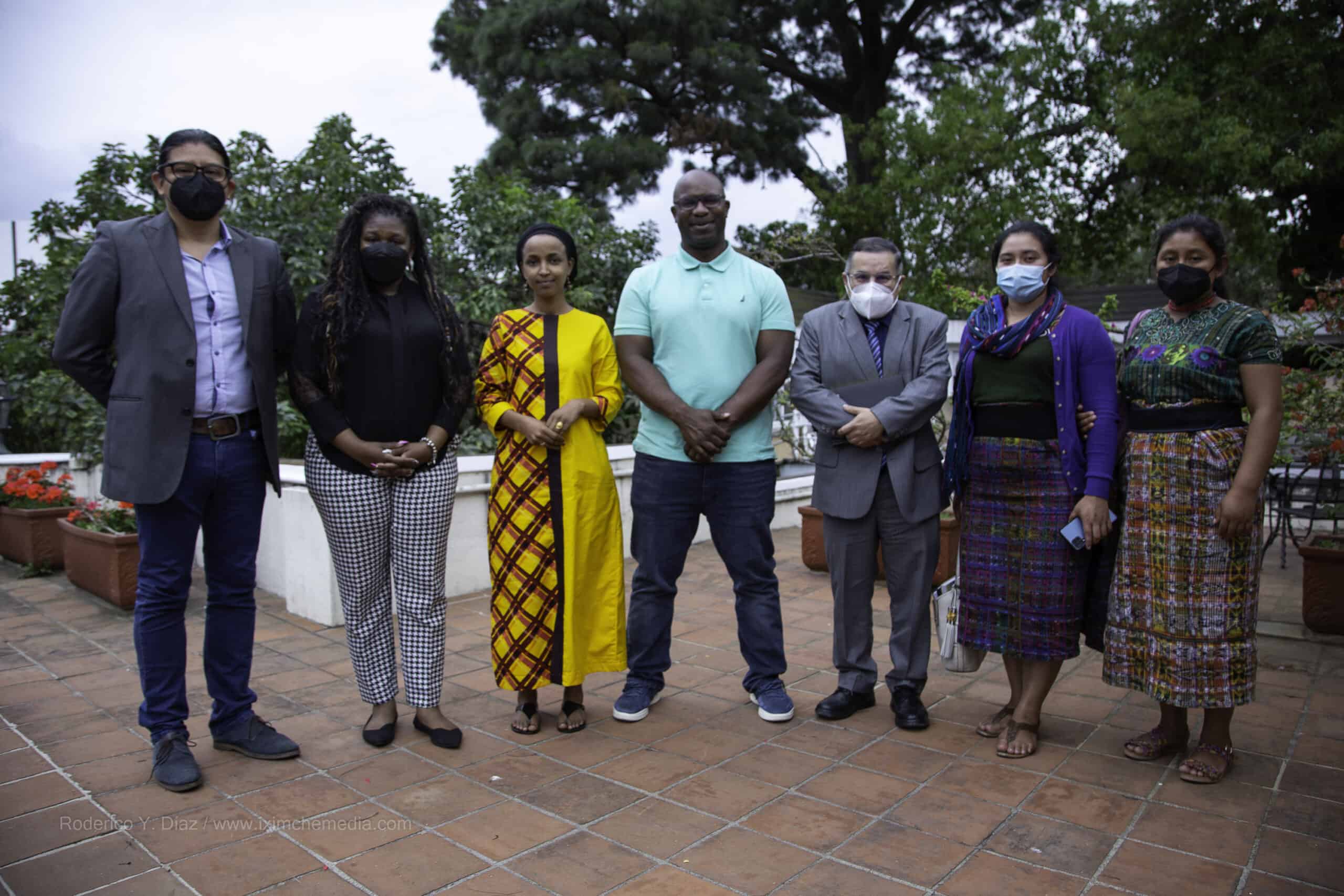
In 2022, NISGUA organized a transnational delegation of U.S. Congress members to Honduras and Guatemala to examine the root causes of forced migration. Delegates met with survivor organizations, Indigenous Authorities, and communities resisting extractive projects, learning about state violence, impunity, and neoliberal resource extraction. Through these exchanges, they learned about state violence, impunity, criminalization, and the impacts of neoliberal resource extraction. The visit strengthened cross-border solidarity and advanced policy commitments to support human rights defenders.
Learn more about the delegation and the lessons they took from these communities here.
📸 U.S. Congressional Delegation Visit – U.S. Representatives Ilhan Omar, Cori Bush, and Jamaal Bowman, alongside staff from Rep. Schakowsky and Rep. García’s offices, meet with Guatemalan organizations during their fact-finding mission to Central America.
The Trans-Territorial Table, organized by NISGUA in 2022 and 2023, created a virtual space for connection and collaboration between organizers, activists, artists, and grassroots organizations in Guatemala and the organized Guatemalan diaspora in the United States. Participants exchanged experiences, strategies, and visions to strengthen collective struggles in defense of life, land, and community. The project also provided small stipends to support activities and initiatives connected to participants’ ongoing work and resistance.
📸 Logo of the 2023 Trans-Territorial Table
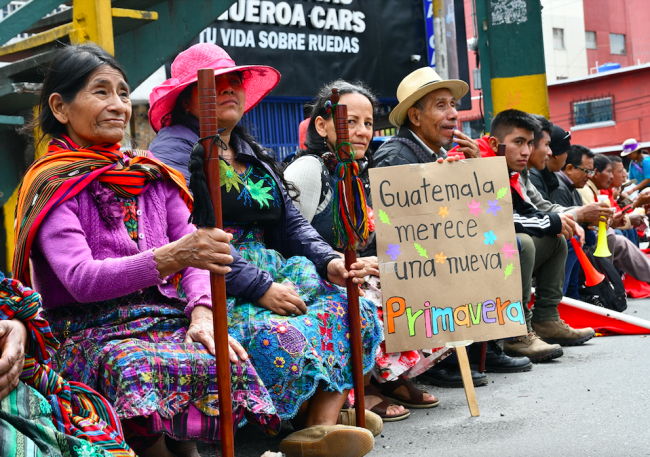
In October 2023, Indigenous Authorities across Guatemala called for a National Strike to defend democracy and the will of the people following attempts to undermine the electoral results. For 106 days, Indigenous leaders, communities, and allies organized peaceful road blockades, gatherings, and permanent protests across the country, including in Guatemala City. The mobilization became a historic movement led by Indigenous Authorities to demand transparency, respect for the popular vote, and an end to corruption.
During the strike, on October 28, 2023, Xinka community leader Noé Gómez Barrera, a member of the Ancestral Authorities of the Xinka Parliament who had participated in the mobilizations, was assassinated in Jutiapa, highlighting the risks faced by Indigenous leaders defending democracy and territory. Read more about the assassination of Xinka leader Noé Gómez Barrera here.
📸 Indigenous Authorities gather in peaceful protest during Guatemala’s 2023 National Strike. Photo by Carlos Ernesto Choc.
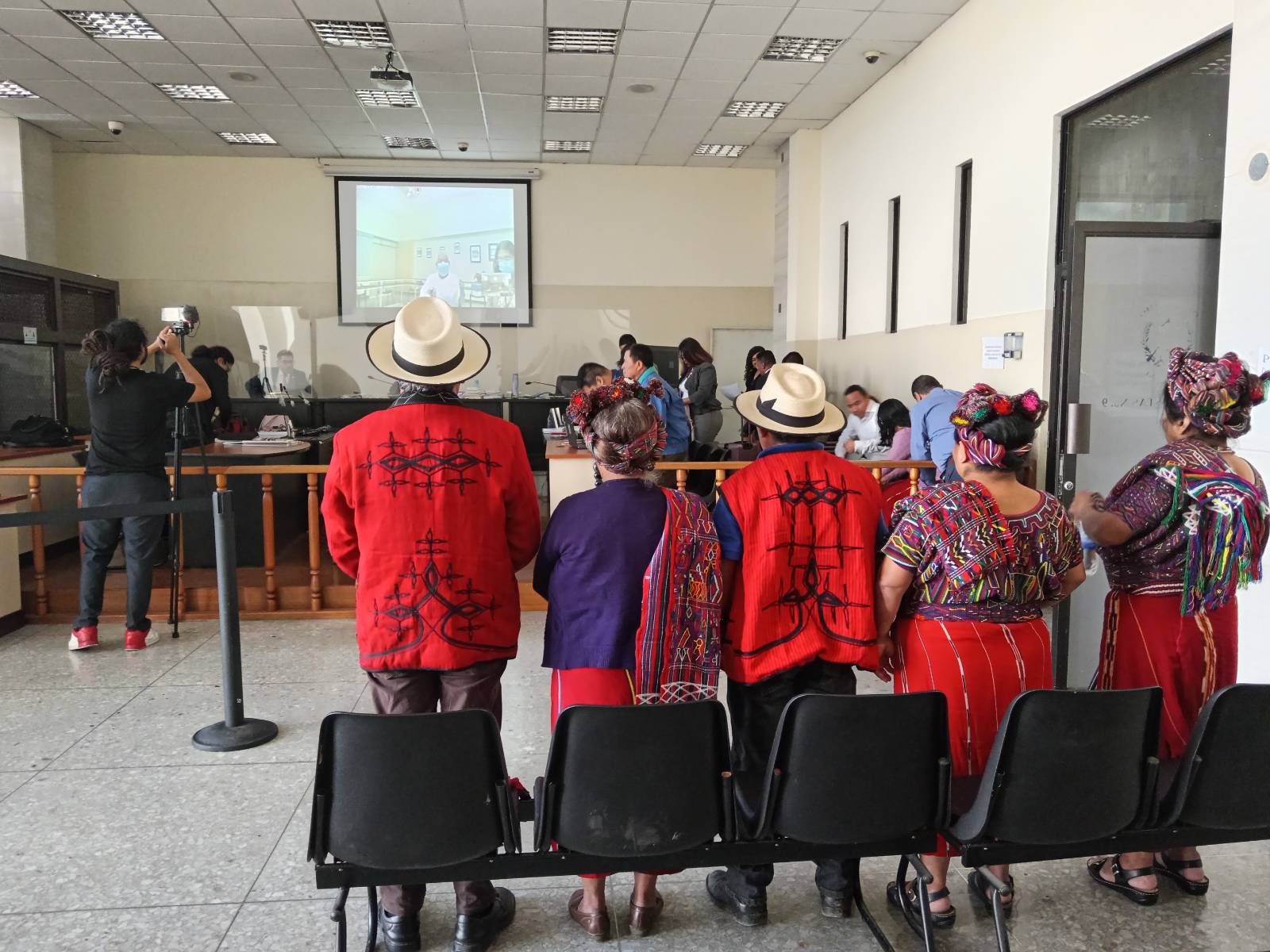
In 2024, struggles for transitional justice in Guatemala continued amid both setbacks and international solidarity. After 99 hearings and testimony from more than 150 witnesses, an appeals court annulled the genocide case against former general Benedicto Lucas García, forcing the trial process to restart and underscoring the persistent obstacles faced by survivors seeking justice. That same year, NISGUA organized a delegation of diaspora youth from the United States and Puerto Rico who accompanied hearings in the genocide case and met with members of the Association for Justice and Reconciliation (AJR) in Rabinal, strengthening transnational solidarity with survivors’ ongoing struggle for justice.
2024 also marked 25 years since the publication of the Military Diary, a key document that exposed forced disappearances carried out by the Guatemalan military during the Internal Armed Conflict and remains central to ongoing demands for truth, memory, and accountability.
📸 Maya Ixil community members observe a genocide trial hearing in Guatemala City, accompanying the judicial process and continuing their long struggle for truth and justice. Photo by NISGUA, April 2024.
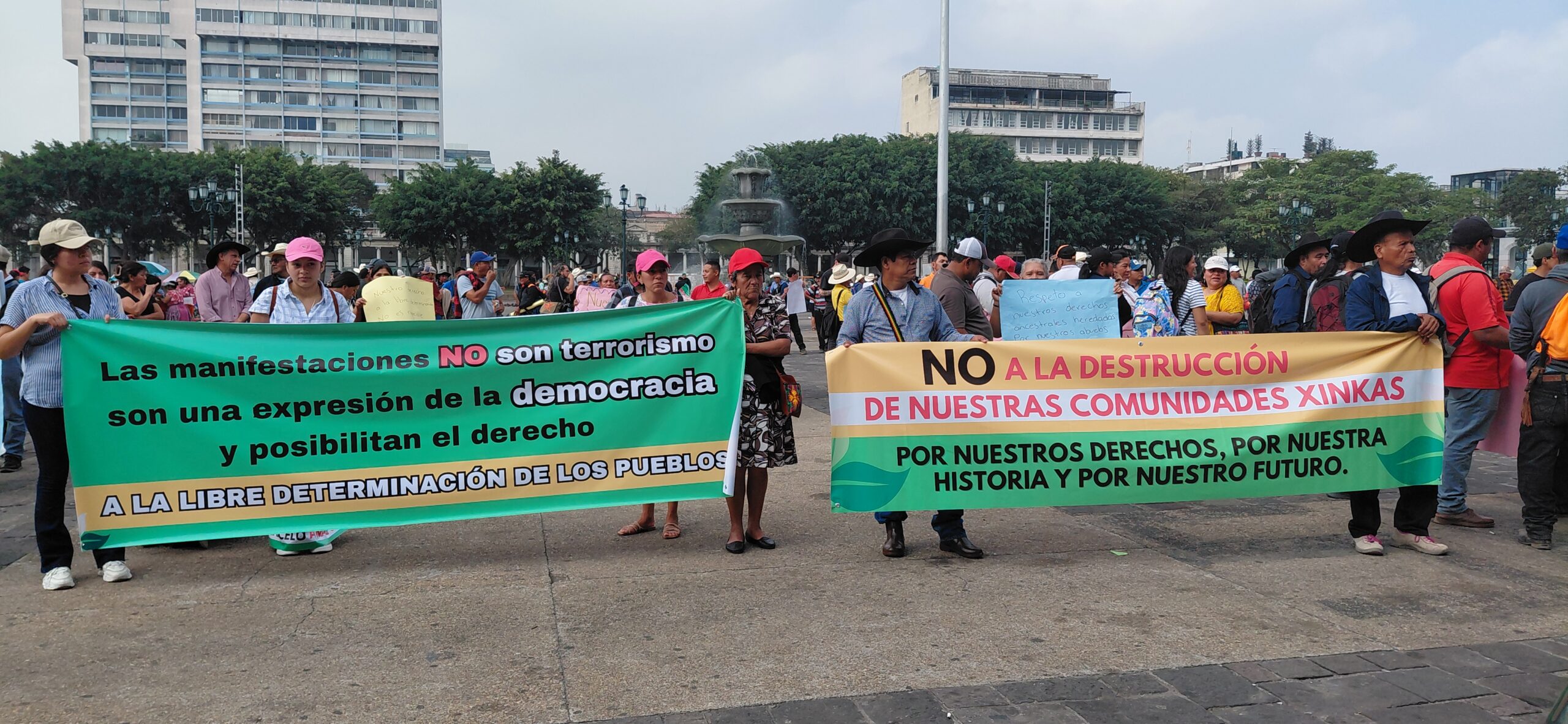
In May 2025, Indigenous Authorities from the Parliament of the Xinka People (PAPXIGUA) delivered the results of the community consultation on the Escobal mining project to the Guatemalan government, following a seven-year process ordered by the Constitutional Court. After more than 15 years of resistance, Xinka communities from Santa Rosa, Jalapa, and Jutiapa clearly said NO to the Escobal mine, currently owned by Pan American Silver. During a press conference, Xinka Authorities also read a public statement that you can read here.
📸 Members of the Xinka people gather in Guatemala City during the presentation of the results of the community consultation on the Escobal mining project. Photo by NISGUA, May 2025.
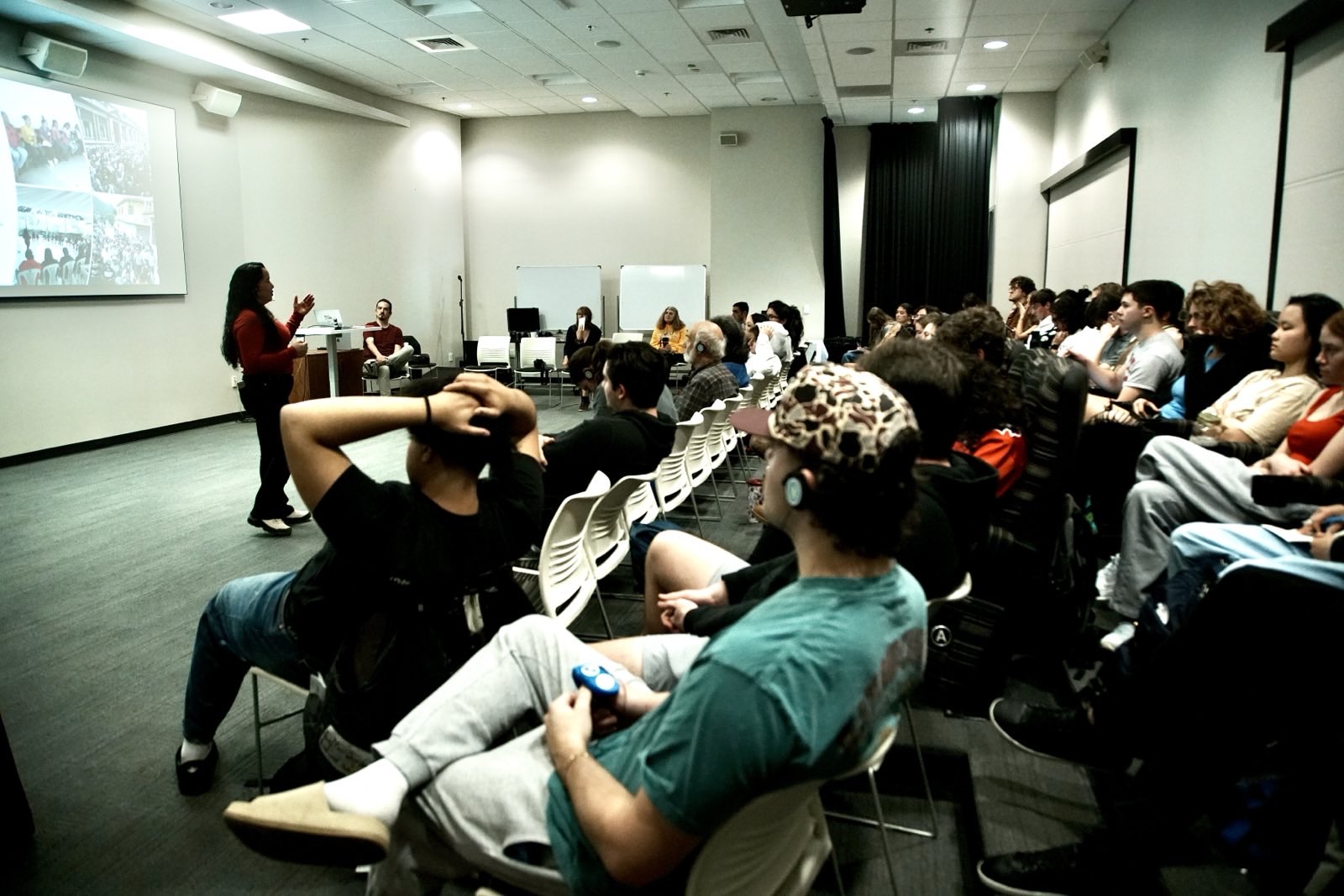
In 2025, NISGUA organized a speaking tour across North Carolina with Sheny Lemus, a Xinka representative from CODIDENA (Diocesan Commission in Defense of Nature). Through events in universities, churches, and community spaces, the tour shared the ongoing struggle of the Xinka people to defend their territory and water from the Escobal mining project.
The tour strengthened international solidarity networks following the Xinka community consultation that categorically rejected the mine. You can read the tour report here.
📸 Sheny Lemus speaks at a university event during NISGUA’s North Carolina speaking tour in 2025. Photo by Roderico Díaz, October 2025.
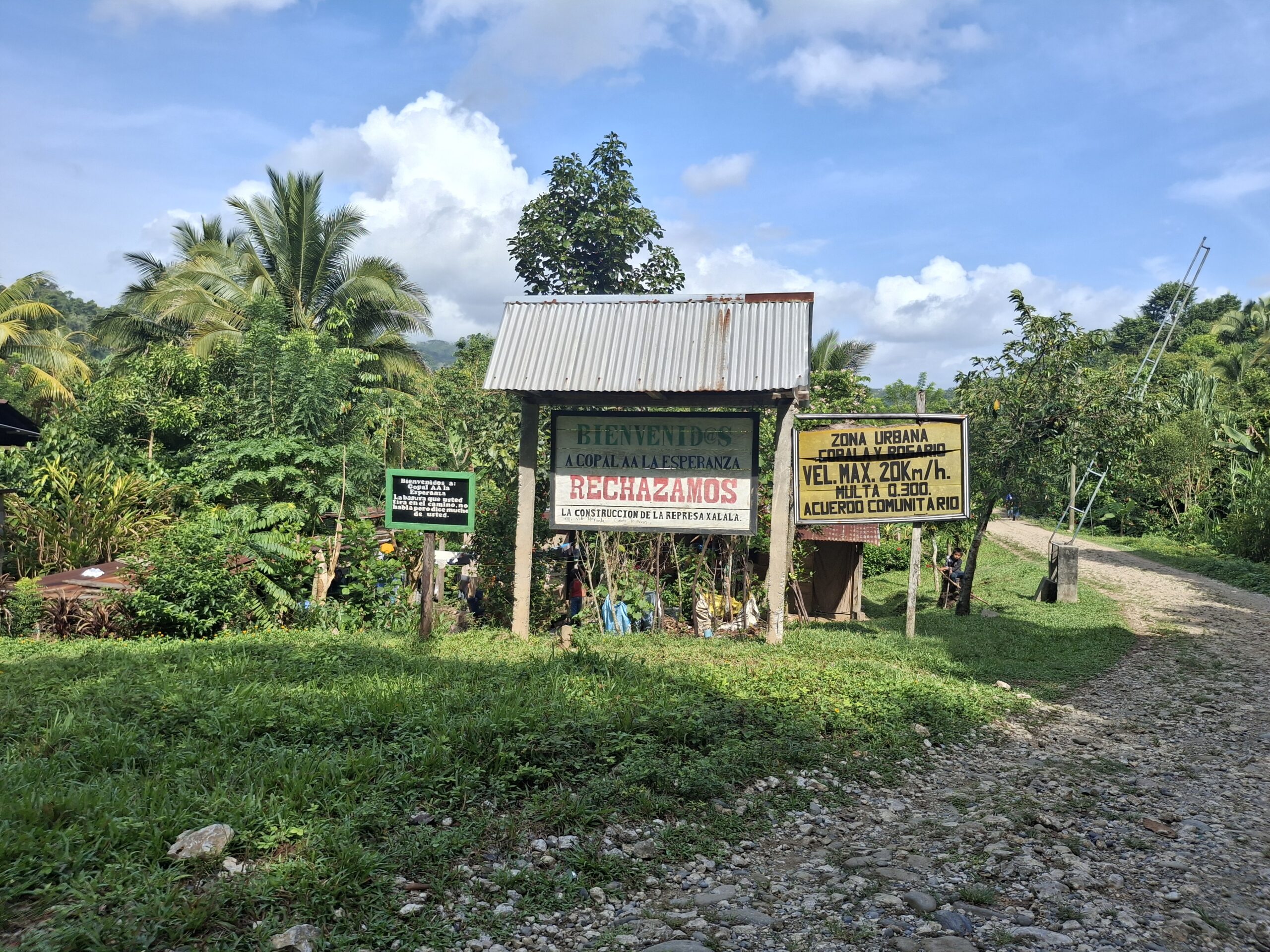
In January 2026, the community of Copal AA La Esperanza celebrated 30 years since its founding by refugees—primarily Mam and Q’anjob’al Maya—who returned from exile in Mexico after the Peace Accords. Since then, the community has remained organized in defense of its territory, successfully opposing the Xalalá hydroelectric project and promoting environmental education and care for Mother Earth. Watch the video to hear community members reflect on life in Copal AA today, climate change, and the relationship between Guatemala and the United States.
📸 Sign posted at the entrance to the Copal AA La Esperanza community stating that they reject the construction of the Xalalá hydroelectric dam. Photo by NISGUA, June 2025.
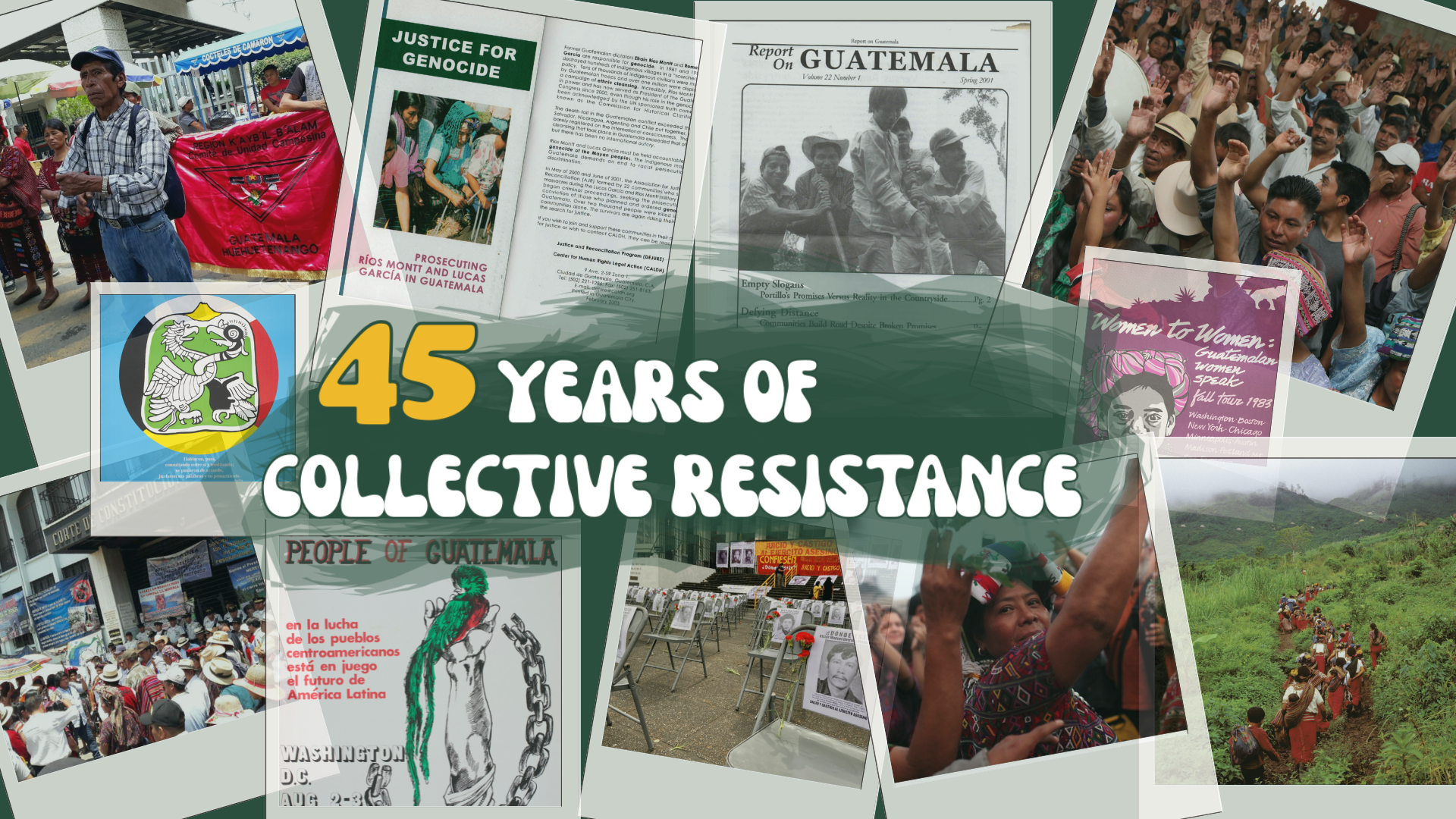
In 2026, NISGUA celebrates 45 years of solidarity with communities in Guatemala defending land, life, and dignity. Rooted in grassroots organizing and cross-border solidarity, this work has been shaped by the leadership and resistance of Indigenous Peoples, survivors, and social movements.
As we mark this anniversary, we celebrate the collective struggles, relationships, and communities that have made this work possible, and we express our deep gratitude to everyone who has been part of this movement over the past 45 years.
📸 45 years aren’t just celebrated — they’re honored! NISGUA marks four and a half decades walking alongside the people of Guatemala — resisting, documenting, and demanding justice. This is our history. This is our strength.