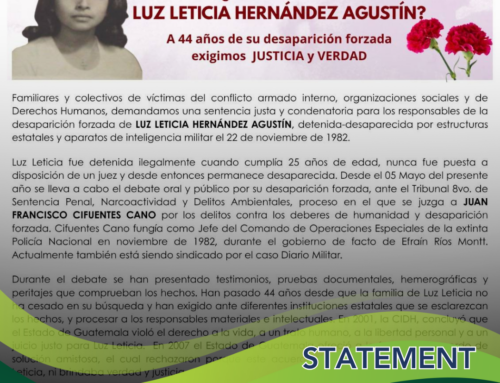
On September 17, a Guatemalan court will finally answer a question her family has been asking since 1982.
The last day anyone saw her
On November 22, 1982, Luz Leticia Hernández Agustín turned 25. It was her birthday — and it was the last day anyone ever saw her.
That day, state forces detained her under the de facto government of General Efraín Ríos Montt, in the deadliest stretch of Guatemala’s internal armed conflict. She was never brought before a judge. No arrest record. No explanation. Nothing. She became one of the more than 45,000 people forcibly disappeared in Guatemala — one more name in a system built to make people vanish, and to make their families live in fear forever.
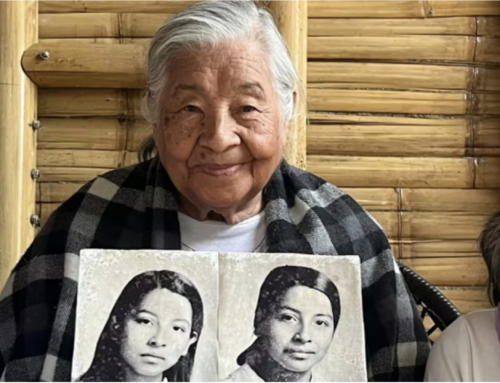
But her family made a different choice. Her parents, Doña Valentina and the late Don Jorge, never stopped searching for their daughter. And her sisters, Marta and Mirtala, picked up that search and carried it in their own way. Not one day stopped, in 44 years.
A long road to justice
The family has been seeking justice almost longer than many of us have been alive. In 2001, the Inter-American Commission on Human Rights found that the Guatemalan state had violated Luz Leticia’s most basic rights — life, liberty, humane treatment, a fair trial — and urged the state to find her remains and prosecute those responsible. Six years later, the government offered the family money. Money, but no truth, no accountability, no remains. Marta and Mirtala said no.
It took until 2023 for prosecutors to charge Juan Francisco Cifuentes Cano, former commander of a special operations unit of the National Police, with crimes against humanity and enforced disappearance. And then came more years of appeals, delays, technicalities. The trial finally opened on May 5, 2026, in Guatemala City.
Since then, three days a week, the sisters have climbed the stairs to the fifth floor of the Palace of Justice. They sit through hours of testimony, notebooks filling up in their laps. Some days reopen wounds that never quite healed. Some days the whole thing dissolves into paperwork. They go home exhausted. They come back anyway.
What they said in court
When it was time for the closing statements, Marta didn’t mince words. The crime, she told the court, has been “devastating, personally, familiarly, and socially.” His guilt was fully demonstrated — and she would know: she spent six months volunteering in the Historical Archive of the National Police, the very archive whose documents helped prove it. She asked for the maximum sentence: 170 years. And she asked that every bit of the damage be repaired.
She also named something that is easy to overlook: what it costs to sit in that courtroom. During these months, she said, the defense twisted the truth. She was the target of slander, of defamation, of lies. “That is why I ask for justice,” she said.
About the man in the dock, she was precise: “He was a public servant in 1982. He knew what the law was. But he decided to serve the macabre plans of the Guatemalan Army.”
Mirtala spoke differently. She barely spoke about the accused at all. She spoke about Leti.
“I want to remember the love of my sister — her kindness, her compassion, her love. We do not want to forget her, and we are not going to. She lives in us through each of her actions. Today we reclaim her right to life, and her right to fight.”
Then she thanked the court for its professionalism, and asked for a conviction — “after no less than 44 years of waiting.” And she widened the lens: “These are not only our rights. They are the rights of the peoples of the territories — for water, for life, for food, for health. We claim all those who defend rights, too.”
September 17: the verdict
The verdict will be read on September 17, 2026. For Marta and Mirtala, it will be the first answer the state has given them in more than four decades.
We’ll be following closely and sharing the outcome on our social media as soon as it’s known. You can hear the sisters in their own words here (with English subtitles):
Memory does not fade
Whatever the court decides on September 17, some things are already settled. Forty-four years of silence did not erase Luz Leticia. It did not erase her from her sisters’ hearts, and it has not erased her from Guatemala’s story.
There will always be people like Luz Leticia in Guatemala — people who look at injustice without looking away, and who believe their country could be a better place for everyone. That’s all she wanted. That’s what her parents, Doña Valentina and Don Jorge, spent their lives searching for — and what Doña Valentina, her sisters, and thousands of other families of the disappeared are still fighting for today.
As Mirtala told Common Dreams earlier this year: “We are like an ant carrying a single grain of salt. This is how dust turns into sand, then into a gust of wind, and finally into a storm.”
We will keep looking for her. Until we find her.