Internacionalista Manni Spicer Saavedra (he/him) wrote this reflection in August 2026.
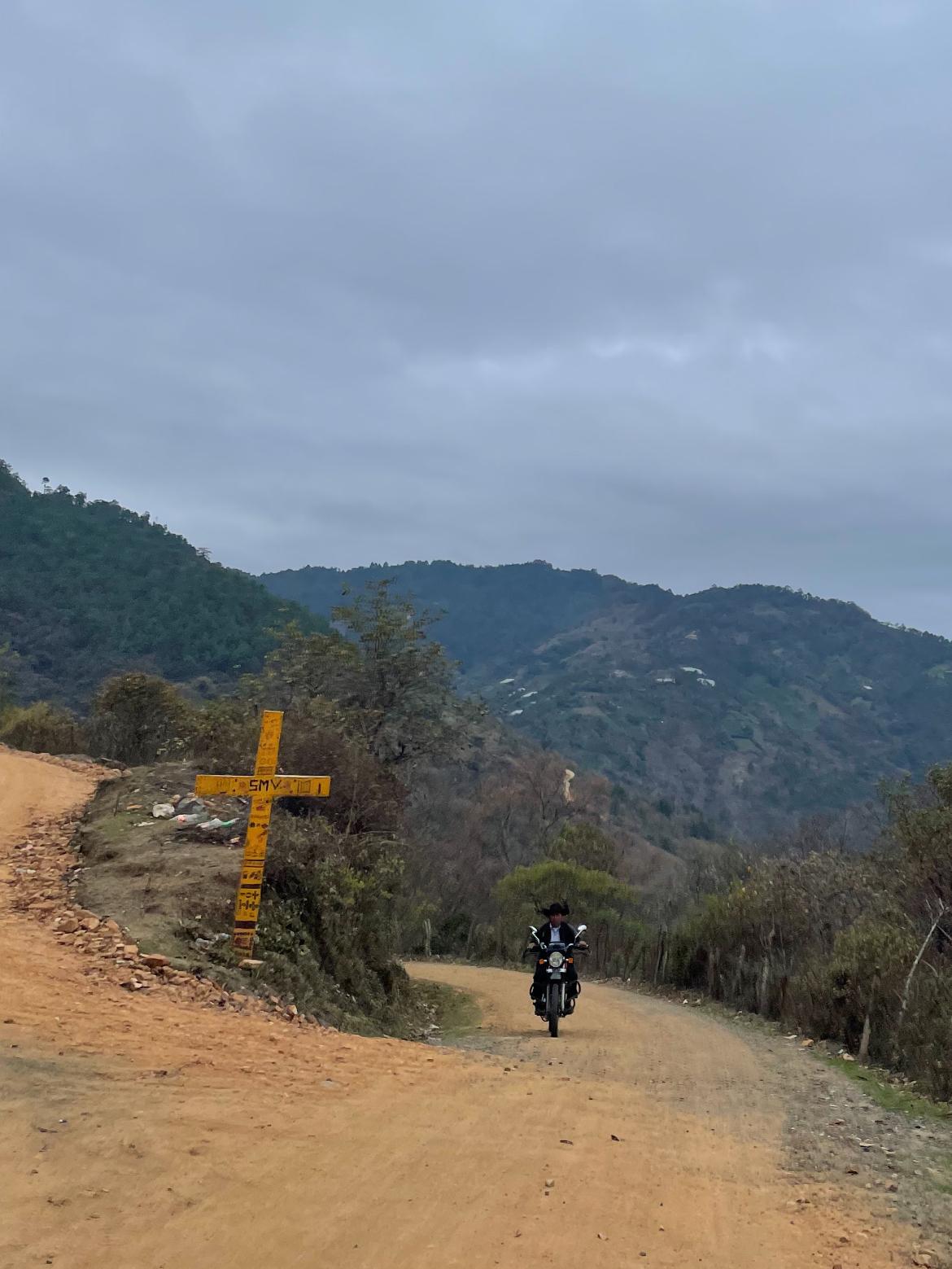
In the rural Rabinal region, finding adequate transportation across thin and winding dirt roads can prove challenging. Photo by NISGUA, 2026.
With a fellow accompanier, I wait on a highway overpass for a taxi that has now cancelled three times in a row, watching a little black car icon make progress, stall and inevitably double-back like a little fly aimlessly through the traffic-jammed arteries of the city. A tree shades us; the sun is, admittedly, pleasant. We have just de-boarded a re-purposed and decked-out elementary school bus—the infamous “chicken buses” of Guatemala—after a five-hour-long journey through nauseatingly thin and winding dirt roads. To catch this bus, we had walked 45 minutes up a mountain from our previous night’s host, whom we reached by yet another series of taxis, buses, and ad-hoc pick-up routes in the neighborhood.
The directions we followed to get here: down; find the crossing in the river; arrive at the daughter’s house and call out her name; pass the Quetzal-painted rock; reach the crossing marked by the Ferromax billboard; wait; wait; wait, or keep walking to find another ride; get in!; get out; follow the only road down into the village and find me working in the ditch; now, climb the mountain.
For all the exertion it cost us, we came to this region rather unceremoniously. Unlike other salidas that I had done previously, where communities had invited us to commemorate the anniversary of a massacre or to accompany a foreign delegation coming to their territory, this trip felt unwarranted. There was no event to attend; no meetings to jump in on; no press release or interpretation needed; no security incident that called us to be present. In effect, I was there only to be introduced to our contrapartes and familiarize myself with their community. Early mornings and fickle taxis to long-haul buses, waiting hours on the side of the road for a pick-up truck that may in fact never come, and so, so much traffic—all to simply sit down, drink a cup of coffee, and be present with those whom we hold relationships with.
At this point as an accompanier, I had already reckoned with the high level of patience required by the job—that “accompaniment” would entail such long distances travelled, costing hours of logistical planning and pushing the body to exhaustion. Yet for this particular salida, I could not help but ask myself: what does all of this work amount to? Why would we endure such a journey if there was no tangible result?
In the end, what value does our presence add to those contrapartes with whom we claim to be in solidarity?
Exhausted at the top of a highway overpass, my newfound doubt prompted a reflection on the legacy of accompaniment that brought us to this point. That reflection, of my place in this larger history, follows below.
The Violence that Drew the World’s Attention
In concrete terms, this accompaniment is what I do for NISGUA, the Network in Solidarity with the People of Guatemala. To some, I have explained somewhat irresponsibly what that means on a day-to-day basis. I have used the image of a “human meat shield” to get across the idea of me, a stone-cold, interchangeable and, by virtue of carrying a U.S. passport, valuable body standing in between a vulnerable person—be they a high-profile witness, indigenous land-defender or dissident journalist—and state violence.
I’ll dig more into why that image is problematic in a moment; for now, it’s useful, at the very least to explain a particular theory that lies behind international accompaniment—that is, protective presence. This theory emerged in the 1980s among groups in Europe and the United States who became aware of the extraordinary violence occurring in Central America at that time–namely, in Guatemala, El Salvador and Nicaragua. NISGUA itself emerged in 1981, when the military regime propelled Guatemala’s already-protracted Internal Armed Conflict into a distinct period marked by a yet-to-be seen brutality over the civilian population. High ranking generals such as Benedicto Lucas García and soon-to-be dictator Efraín Ríos Montt carried out violent purges of the countryside meant to eradicate the insurgent guerrilla movement, whom they labelled the “internal enemy.”
In reality, however, the “internal enemy” could be conveniently made out of any subject that the state sought to discipline: teachers organizing a union; indentured plantation workers and campesinos demanding their paycheck; unwed women; Catholic clergy members distributing mutual aid; and, most violently, indigenous peoples, who refused full assimilation into the modern nation of Guatemala. Thus, in 1982, Ríos Montt—backed politically, technically and financially by the United States—specifically targeted the Maya Ixil community in the remote northern department of Quiché to purportedly “battle leftists” with a carefully devised scorched-earth campaign (1). Instead of purging the militant communist organizations from the country, the violence that ensued devastated the Indigenous civilian population; by the time said campaign was over, from 70 to 90 percent of Maya Ixil communities had been razed to the ground (2).
Such systematic killing, torture and dispossession would bring both Ríos Montt and Lucas García to trials for genocide—the latter of which, after 99 hearings held in 2024, the defense succeeded in annulling the trial and sending it back to an earlier procedural stage, a process that has yet to take effect.
The Shortcomings of Protective Presence
In response to these atrocities, solidarity groups in the Global North—primarily from the United States, Canada and Western or Northern Europe—developed protective presence as a strategy of deterrence. They flew in and put their bodies on the ground, with the idea that being present and bearing witness would not only prevent such violence, but also draw international attention to these human rights violations that otherwise might be easy to sweep under the rug of history.
This theory of protective presence works on two driving assumptions: first, that some bodies are more valuable than others to the international community, and those worth more can step in to protect populations that are vulnerable to state violence. The worth of these bodies cannot be taken for granted; rather, it is arbitrated by very specific orders of power that have privileged certain individuals over others in terms of capital, cultural clout and, most relevant to accompaniment work, international attention. In general, citizens of the global North, and in particular White ones, have the money and travel privileges to buy a plane ticket out when things get tight; their unique sway in media coverage and far-reaching social connections hold any potential harm done to them accountable; and, they have unique access to national or international levers of power that might act against human rights violators.
Thus, protective presence remains useful on the basis of a second assumption: that the so-called “international community” remains an interested, coherent and legitimate political actor in keeping state violence in check.
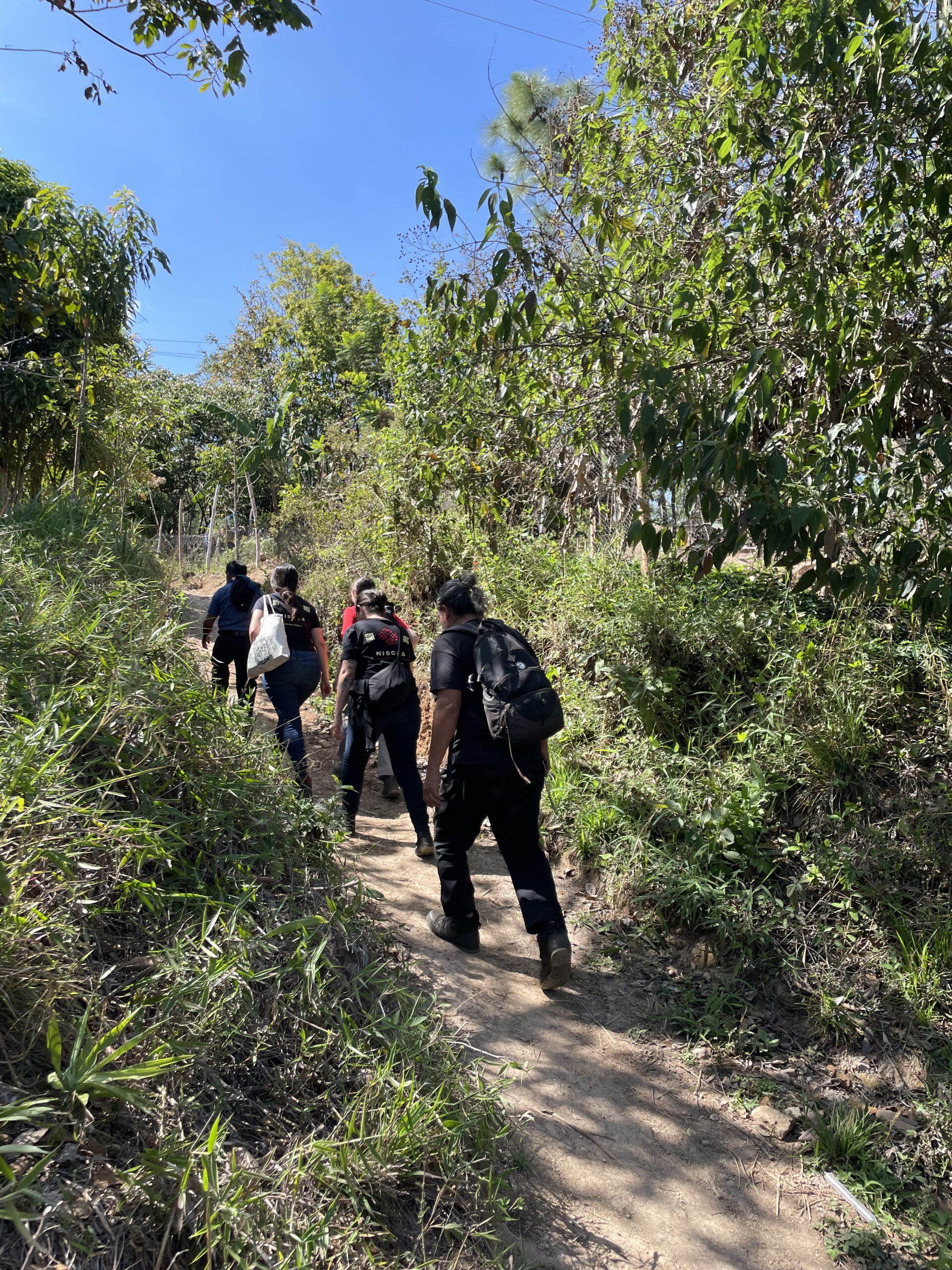
A group of NISGUA accompaniers walk back from an inhumacion ceremony in Chimaltenango, Guatemala. Photo by NISGUA, April 2026.
For those who were raised to hold the value of their life as given—lives guaranteed and maintained by a slew of medical, educational, and juridical rights—the first assumption might be easy to make. Speaking for myself, I have never doubted my life to be valuable nor had to fight for that value to be recognized. With my liberal California-social-justice upbringing, I have been actively invested in by social and financial capital to “go out and do good in the world.”
Yet, by reflecting on where I stand in relation to our contrapartes, it’s clear that my body—equipped with a formal-looking vest and a U.S. passport—derives its value from systems of capital and cultural exchange that exactly devalue Guatemalans: the colonial hierarchy, labor politics and global mobility I benefit from at their expense. This value draws from a well of global power maintained by the United States of America, with its far-reaching cultural influence and a demonstrated history of interventionism acting as a sort of shield that guards my back. Without it, my body would be just as vulnerable to the violence that our contrapartes are threatened by.
In contrast to this easily assumed power I access as an accompanier, our contrapartes must organize themselves precisely to insist on the value of their lives despite the state that once so plainly disposed of them in the Internal Armed Conflict—one which continues to dispossess them of their land and autonomy.
This is the baggage of accompaniment that I am unpacking in my role with NISGUA today. As accompaniment evolves as an ongoing strategy for international solidarity, it is upon accompaniers like myself to reckon with that position and actively challenge its assumption of power. This reflection is part of that reckoning.
By valuing ourselves not for our proximity to powerful institutions but rather by the strength of the relationships we build with our contrapartes, we might better sustain the long-term struggle for self-determination throughout the Global South as it breaks from the standards and interests of the Global North.
The Breakdown of International Norms
Not only does this breakage serve our political commitment to value whom we accompany on their own terms; in the face of the breakdown of international norms, it is also increasingly a practical necessity. While deterrence remains a factor in international accompaniment, our contrapartes are certainly not asking us to step in and “protect” them. Communities might deploy accompaniers at specific moments to tactfully face the threat of violence, and our job is to be available should they calculate for themselves the benefit of our presence. In these calculations, one must factor in the state of international politics and, as such, face the continued dismantling of the international order that once bound nations to certain agreements.
The Brexit decision of 2020 and the Trump administration’s repeated attacks on the International Criminal Court are but two examples that demonstrate the anti-globalist strain that has taken over the political right. International bodies that once held clout in domestic politics have, apparently, been weakened by this movement. As the global far-right intensifies its power and eschews the norms once held by even the most conservative of liberal democracies, the international consequences of human rights abuses may no longer be such an effective deterrent to violence.
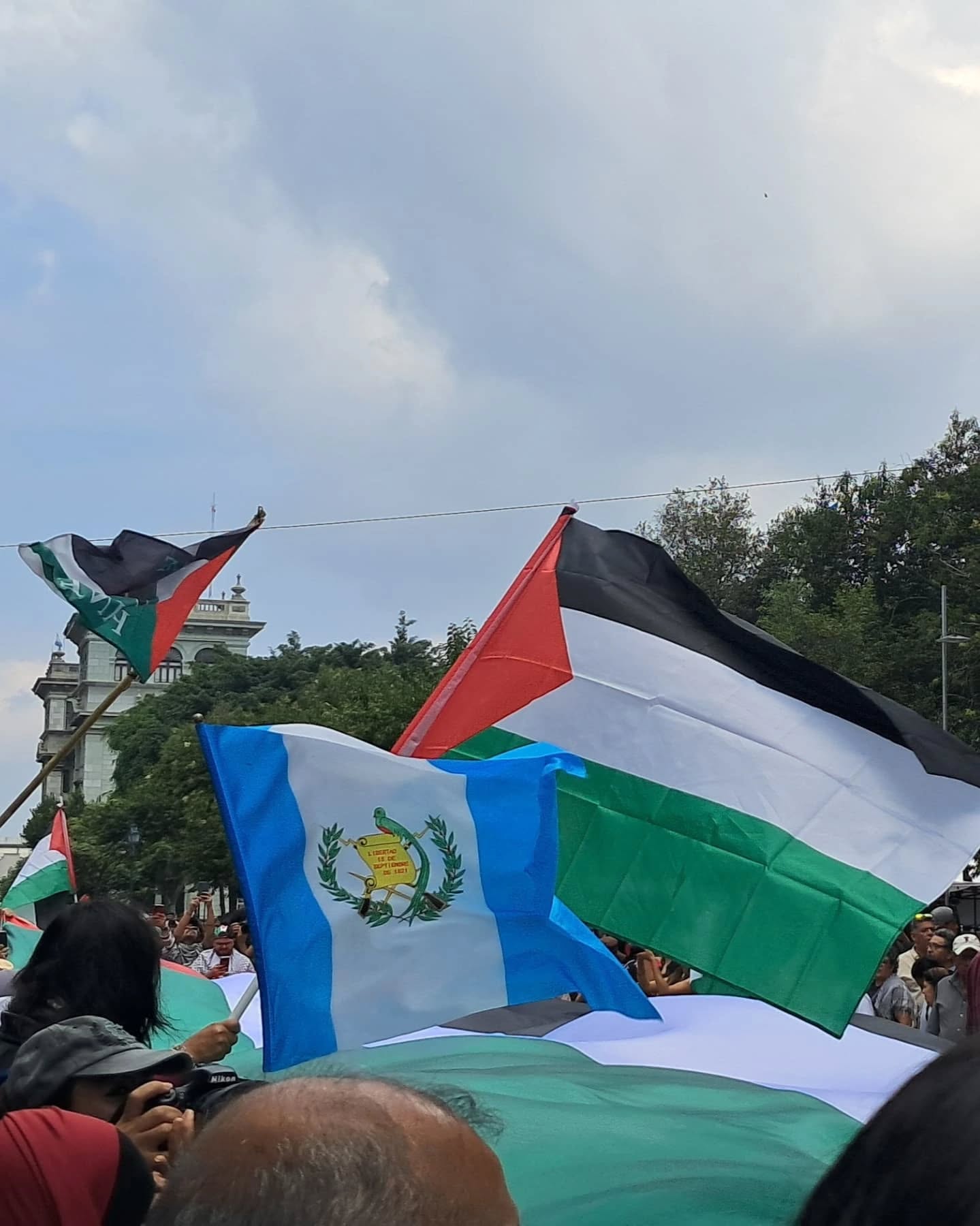
March in solidarity with the people of Palestine and Lebanon in commemoration of one year of terror and genocide committed by the state of Israel. Photo by NISGUA, October 2024.
This brings us to the failure of the second assumption: that the “international community” no longer has the interest, coherence or legitimacy that it enjoyed when accompaniment first developed as a political strategy. Moreover, its supposed concern for human rights, if it ever did exist, has little purchase left in geopolitics—if nothing else, the genocide in Gaza has made this clear.
Guatemala’s genocide bears many differences to the one in Palestine, not least for its deployment of international accompaniers. Unlike in the occupied West Bank, where accompaniers continue to live among Palestinian communities and document, if not deter, Israeli settler violence, the Maya Ixil people did not benefit from such on-the-ground presence. Instead, survivors of these massacres in the 1980s fled alone into the mountains or sought refugee status in Mexico. Only afterwards, once the military regimes fell out of power and these refugees returned to re-form their communities, did our solidarity groups provide protective presence.
These refugees could garner a measure of security—physical and psychological—as White people accompanied their reintegration to civil life. One of the reasons why this protective presence was effective was the fact that, by the 1990s, Guatemala wanted to cleanse itself from the abysmal human rights record of its recent military dictatorship. Military interference with the reintegration process, to which accompaniers had brought international attention, would jeopardize the government’s claimed interest to transition from the brutal authoritarian regime to a civilian democracy.
Today, however, the international appeal for civilian democracy seems to have waned. How, or to whom, then, must we articulate our appeals to solidarity?
Solidarity in this Political Moment
Throughout the years that NISGUA has been supporting accompaniers, the populations at risk of state violence have changed with the agenda of those in power. In the 80’s and 90’s we were directly placed in communities transitioning out of violent conflict. These days, we accompany a variety of groups who bear the consequences of that violence, split between land defenders who fight corporations granted licenses to their land during the war and survivors who now carry cases to prosecute the regime’s military leaders. The former fight against the seemingly endless transnational corporate interests that covet their land; the latter risk exposing the crimes of some of the most powerful people in the country. In both cases, these groups fight against those who got and maintained their power through dispossession of our very same contrapartes that lost their land and livelihood in the armed conflict.
All the more important, then, is the relationship of solidarity that has withstood forty years of violence. Tying together this history with contemporary struggle, long-term accompaniment responds to more than moments of acute violence; it responds to the care and trust we invest into these communities as we have done since that time of armed conflict. With these networks becoming stronger, we need not appeal again to the arbiters of international justice nor rely on this precarious power to step in when violence intensifies.
By continuing to show up in these relationships, we are seeing through a commitment made under much more severe circumstances. While at one time the importance of accompaniers may have been an acute matter of life-or-death, this is not why we keep getting invited back. We are invited back because we have, at one point or another, proven ourselves to be in true solidarity with their struggle, to be trustworthy, to value them where others have not.
The realization brings me back to the long road taken to meet our relationships where they are at. It is exhausting. For a rotating cast of gringos who seem to value their time so much, these trips can feel boring, excessive, uncomfortable. Yet the value of solidarity emerges from the effort of making and maintaining these relationships, not out of self-importance or supposed humanistic concern but out of a historical, principled and sober commitment to their struggle. To disinterest our solidarity from the whims of global geopolitics means to strengthen our commitments to the mundane, the inconvenient and the unsensational.
Once made, we continue on the path laid out by such commitments to solidarity, even when the immediate importance or action is not so clear. The responsibility of carrying these relationships here in Guatemala, which I have stepped into as an accompanier, precedes me. I hope that, as I pass on this role to future accompaniers, I leave these relationships strengthened by good-will, care and lasting solidarity so they may continue to grow.
Sources and suggested further reading:
(1) The New York Times, April 25, 1982. “US Is Said to Plan Aid to Guatemala to Battle Leftists. https://www.nytimes.com/1982/04/25/world/us-is-said-to-plan-aid-to-guatemala-to-battle-leftists.html
(2) CEH (Comisión para el Esclarecimiento Histórico) 1999b. Guatemala: Memory of Silence, pg 40. Guatemala City: CEH
(3) ODHAG (Oficina de Derechos Humanos del Arzobispado de Guatemala). 1998. Guatemala: Nunca Más. Informe del Proyecto Interdiocesano de Recuperación de la Memoria Histórica (REHMI). Guatemala City: ODHAG. https://www.odhag.org.gt/publicaciones/remhi-guatemala-nunca-mas/.